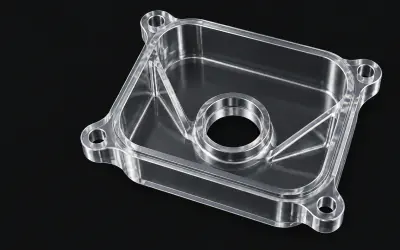
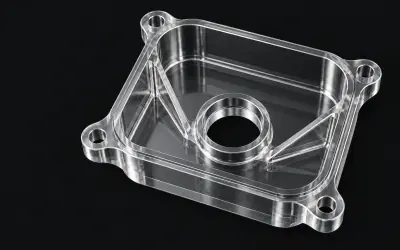
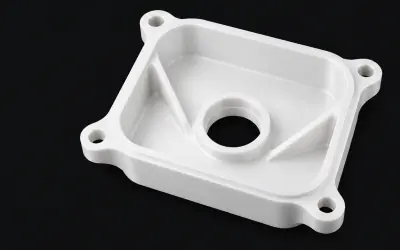
Housings that show the interior
Housings that reveal the mechanism or electronics inside.


SLA resin · Custom parts
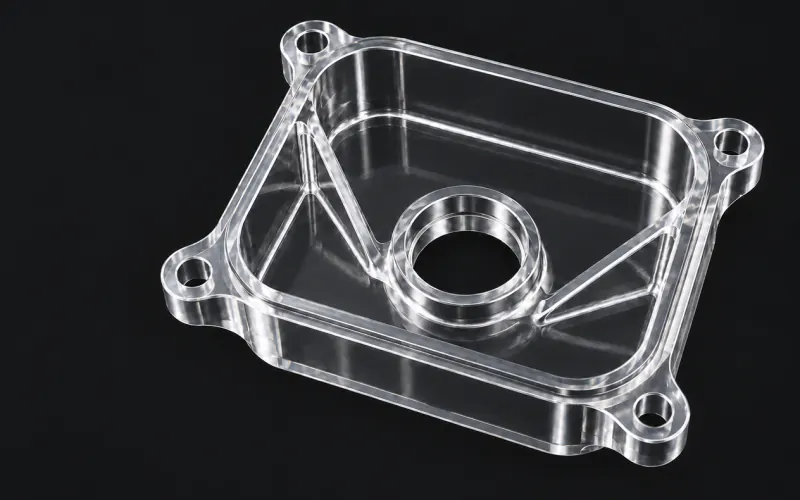
To see through the part. We print in clear resin by stereolithography and always polish it so it is transparent, not translucent.
Get your quoteQuote in 24 h · Engineering review
01 / Why choose this material
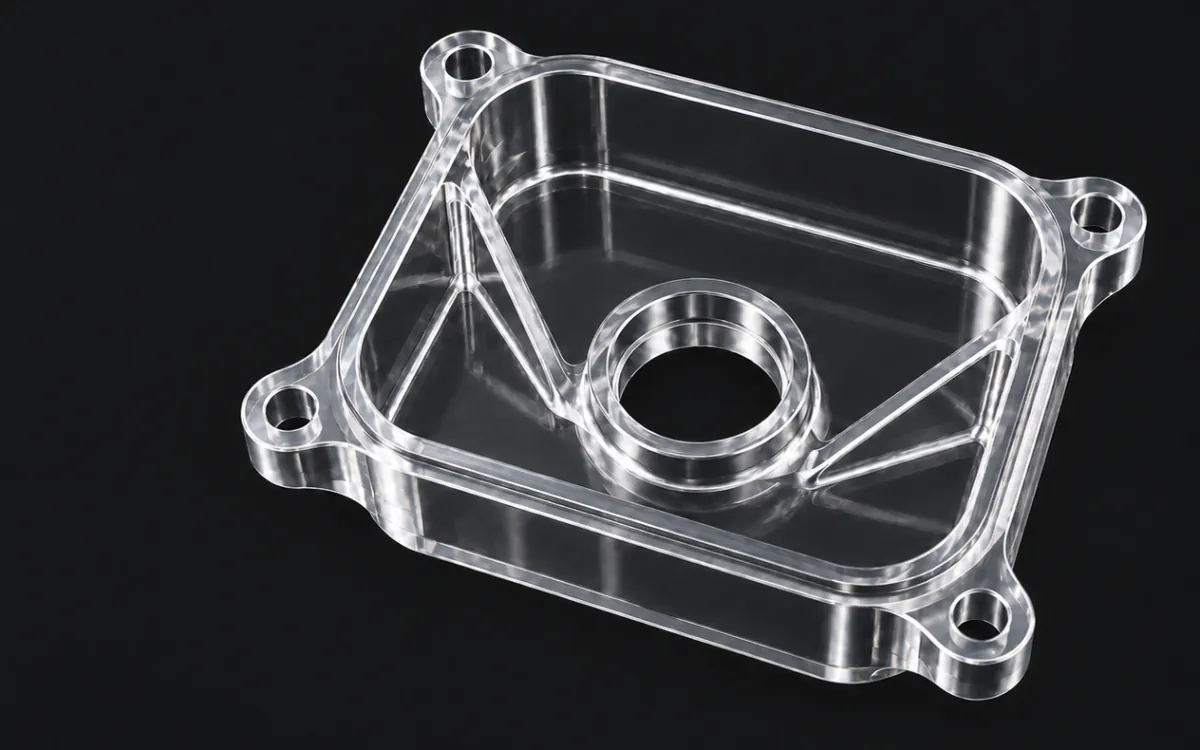
Nearly colorless, water-resistant stereolithography resin, similar to ABS or PBT. With clear polish, which is always included, you can see inside the part; without it, it would be translucent.
Clear resin is nearly colorless and water resistant. When it comes out of the machine it is translucent: each face is sanded, polished, and varnished so you can see inside. That polishing is mandatory and included in the price. Cavities that cannot be reached remain translucent.
Learn about the SLA 3D printing process ↗Reference · Somos® WaterShed XC 11122
Clear polish is mandatory and included. Interior cavities that cannot be reached for polishing remain translucent. It is not suitable for parts that work above 45 °C.
Clear resin applications
Housings that reveal the mechanism or electronics inside.
Light guides, diffusers, and indicator windows.
Parts to see how a fluid or air flows.
Packaging and bottle prototypes to validate shape and volume.
02 / A choice based on usage
These criteria help define the material, geometry, and working conditions before manufacturing.
01
All parts are polished and varnished. It is not offered unpolished because it would remain translucent.
02
Closed interiors and narrow channels remain translucent. If an area has to be seen, make it accessible.
03
For runs with a product look, cast clear PU. For optical parts or higher temperatures, machined PMMA or PC.
Indicate loads, temperature, environment, and appearance needed. If the drawing requires a specific grade, include it in the request.
03 / Finishing also counts
Material and process define the surface. These are the key factors for specifying your part's appearance.
Mandatory and included in the price. Each face is sanded and polished, and a clear varnish is applied: without it, the resin remains translucent. Cavities that cannot be reached remain translucent.
Define thicknesses and areas that must deform or fit. The reference part shows the material, not the behavior of any design.
Include the expected appearance and usage conditions in your request to confirm the quote.
04 / From design to quote
Stereolithography builds the clear resin part layer by layer: an ultraviolet laser cures the liquid resin on a platform. The part grows on thin supports that are then removed and sanded, and it gets a final cure with ultraviolet light.
Upload a 3D model per part, for example in STEP or STL. SLDPRT, X_T, X_B, IPT, CATPART, PRT, SAT, and 3DM files are also accepted. Add a PDF drawing with functional dimensions and assembly requirements.
Upload your file and request a quotePrinting tolerances depend on geometry, orientation, and material. Indicate assembly dimensions on a drawing for the team to confirm feasibility. CNC machining tolerances are not automatically applied.
The price per part usually varies little with quantity. Producing more units does not imply the volume savings achievable with machining or molds.
Parts from 7 working days after confirming the order. The quote specifies the lead time based on geometry, material, finish, and quantity.
How much it costs to manufacture
The price of printing clear resin depends on material volume, geometry, build orientation, and post-processing. Quantity usually reduces the unit cost only slightly.
Check the catalog example to compare materials. To know the cost of your design, request a quote with your 3D file.
Frequently asked questions
Properties, applications, and manufacturing: answers to prepare your request.
Nearly colorless, water-resistant stereolithography resin, similar to ABS or PBT. With clear polish, which is always included, you can see inside the part; without it, it would be translucent. Clear polish is mandatory and included. Interior cavities that cannot be reached for polishing remain translucent. It is not suitable for parts that work above 45 °C.
You can manufacture housings that show the interior, light guides and diffusers, flow visualization parts, and packaging prototypes. Stereolithography allows validating the appearance and detail of a part without manufacturing a mold. Define the loads, environment, and finish so we can review the application.
The resin comes out of the machine translucent, with a hazy surface. Only sanding, polishing, and varnishing make it transparent. That is why Proto&Go! always delivers it polished and includes it in the price.
It is very transparent on the polished faces, with an occasional fine bubble or particle. Inaccessible interiors remain translucent. For optical quality, consider machined and polished PMMA.
SLA resin is the fastest route for one or a few parts. Cast clear PU suits pre-production runs. Machined PMMA or PC, when you need tolerances, higher temperature, or optical quality.
The price of printing clear resin depends on material volume, geometry, build orientation, and post-processing. Quantity usually reduces the unit cost only slightly. Upload the 3D file to the Proto&Go! platform to receive a quote with cost and lead time.
Printing tolerances depend on geometry, orientation, and material. Indicate assembly dimensions on a drawing for the team to confirm feasibility. CNC machining tolerances are not automatically applied.
Upload a 3D model per part, for example in STEP or STL. SLDPRT, X_T, X_B, IPT, CATPART, PRT, SAT, and 3DM files are also accepted. Add a PDF drawing with functional dimensions and assembly requirements.
Compare before choosing
Your next part
Upload the 3D file. We review feasibility and send you the quote.
We use our own and third-party cookies to understand how the website is used and which campaigns work. You can accept them all, reject them all or choose which ones; the website works the same either way. Cookie policy.