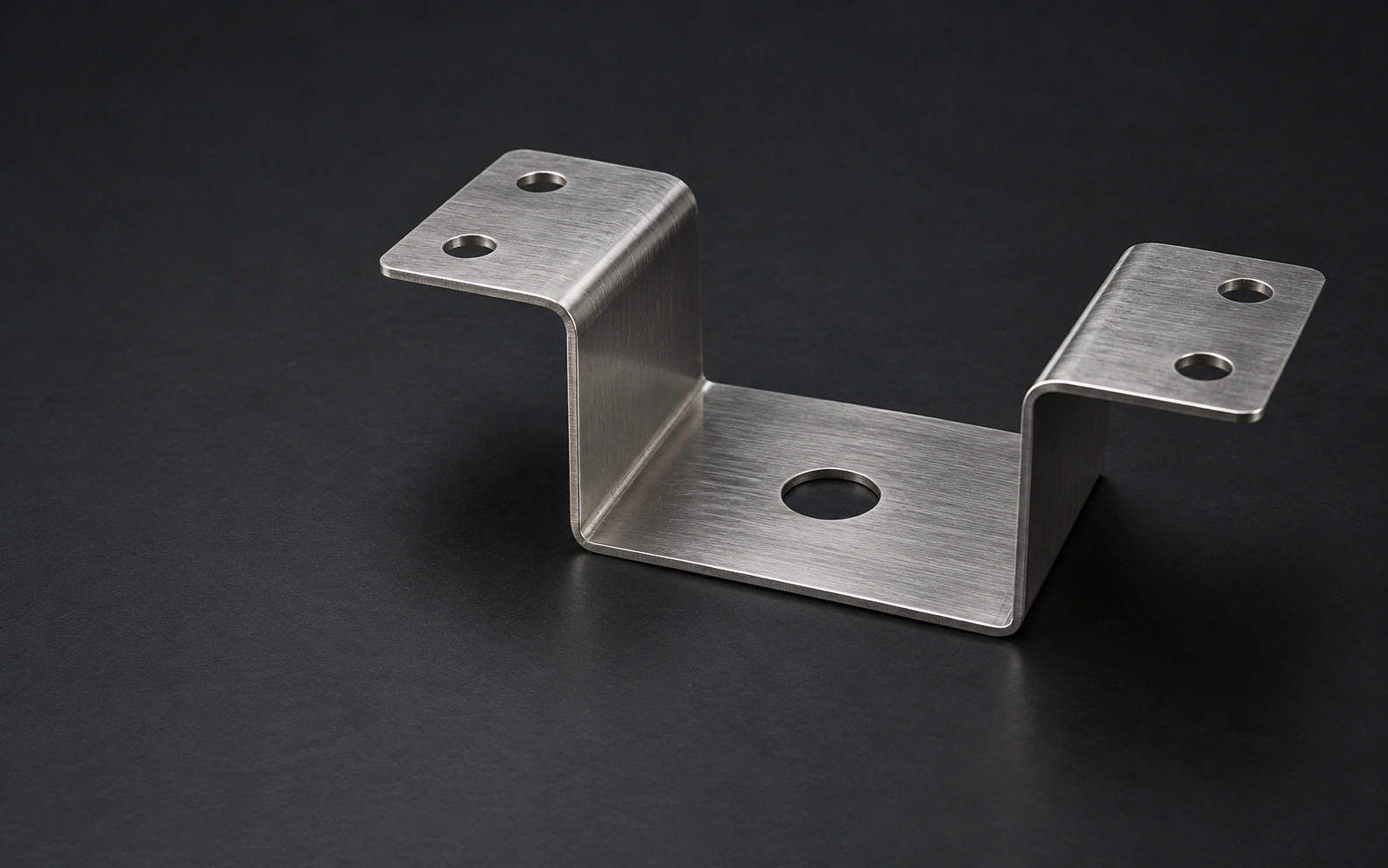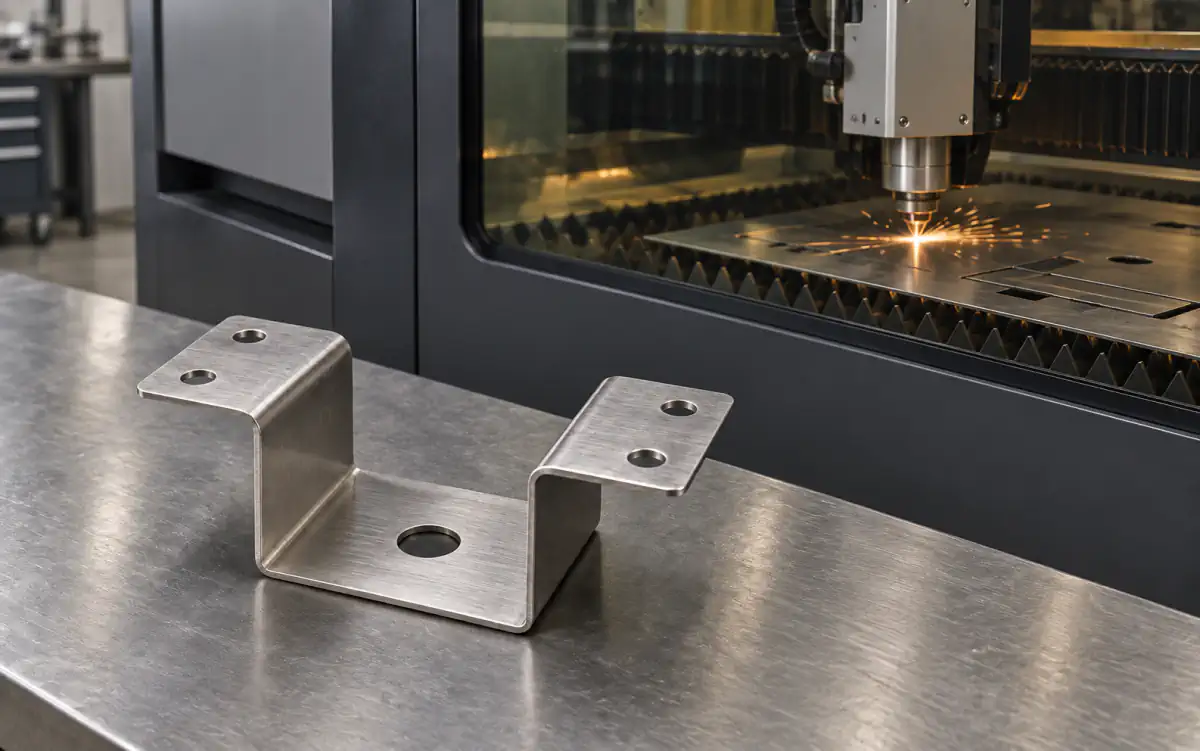
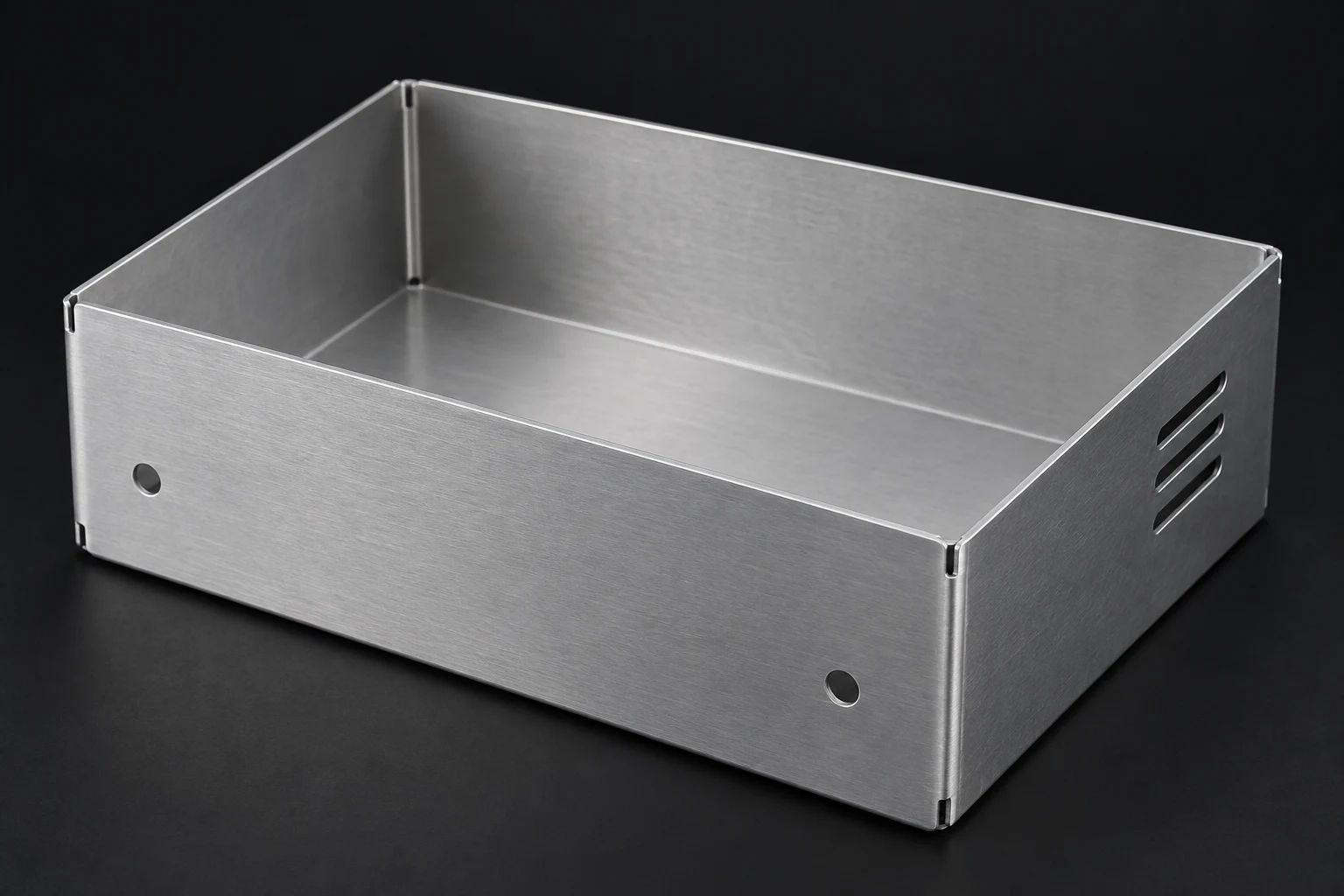
Bent stainless steel support in U-shape with drilled flanges; at the bottom, a laser cutter cutting sheet metal.

Laser Cutting · CNC Bending · From 1 unit

Laser cutting and bending of sheet metal.

Brackets, chassis and enclosures in laser-cut and custom-bent sheet metal, from your 3D file, in small quantities and without tooling.

Quote
24h
Parts in
8working days
Thickness
0,3–15mm
Metals
5datasheets
Extras
Threads· welding

01 / From development to part

It is cut flat.
It is bent in 3D.

We calculate the development of your 3D model, cut it with a laser, and bend each flange to its angle.

Laser cutting mm
0
Bend °
0
Bends
0 / 4
Thickness mm
2,0
01 · LASER CUTTING

Laser cutting

The laser cuts the flat development with its holes and slots, directly from your 3D file.

ContoursHolesSlotsNo tooling
Material

02 / Geometry and stiffness

The strength
of a bend.

The sheet metal shape influences its stiffness. Bent edges can reduce flexing without increasing thickness.

Same material · same thickness · same loadNo load
Flat sheetThe free surface can flex.
Two bent edgesReinforcement in one direction.
Four bent edgesThe outline reinforces the assembly.

Visual demonstration of flexion, without structural calculation.

03 / Finishes

Same part.
Different finish.

Choose the surface your part needs: protection, texture, and color, depending on the metal.

All finishes, by process
Sheet metal bending housing in aluminum without finish
No finishAl · Steel · Stainless Steel · Copper · Brass

Finish representation.

04 / Your order

Your folded part in 3D.
Nothing more.

The 3D model is sufficient to calculate the development, get a quote, and manufacture.

01

Upload your part

One file per part, already folded, in STEP or your CAD format.

STEPSLDPRTX_T / X_BIPTCATPARTPRTSAT3DMPDF · drawing
02

Quote in 24 h

An engineer reviews manufacturability and suggests material, finish, and lead time.

03

Parts from 8 days

We verify each part and ship it to any point in Europe.

05 / Design for bending

Six rules for
sheet metal without surprises.

Small changes facilitate cutting, bending, and assembly of your part.

Enlarge each image to check the details and their explanation.

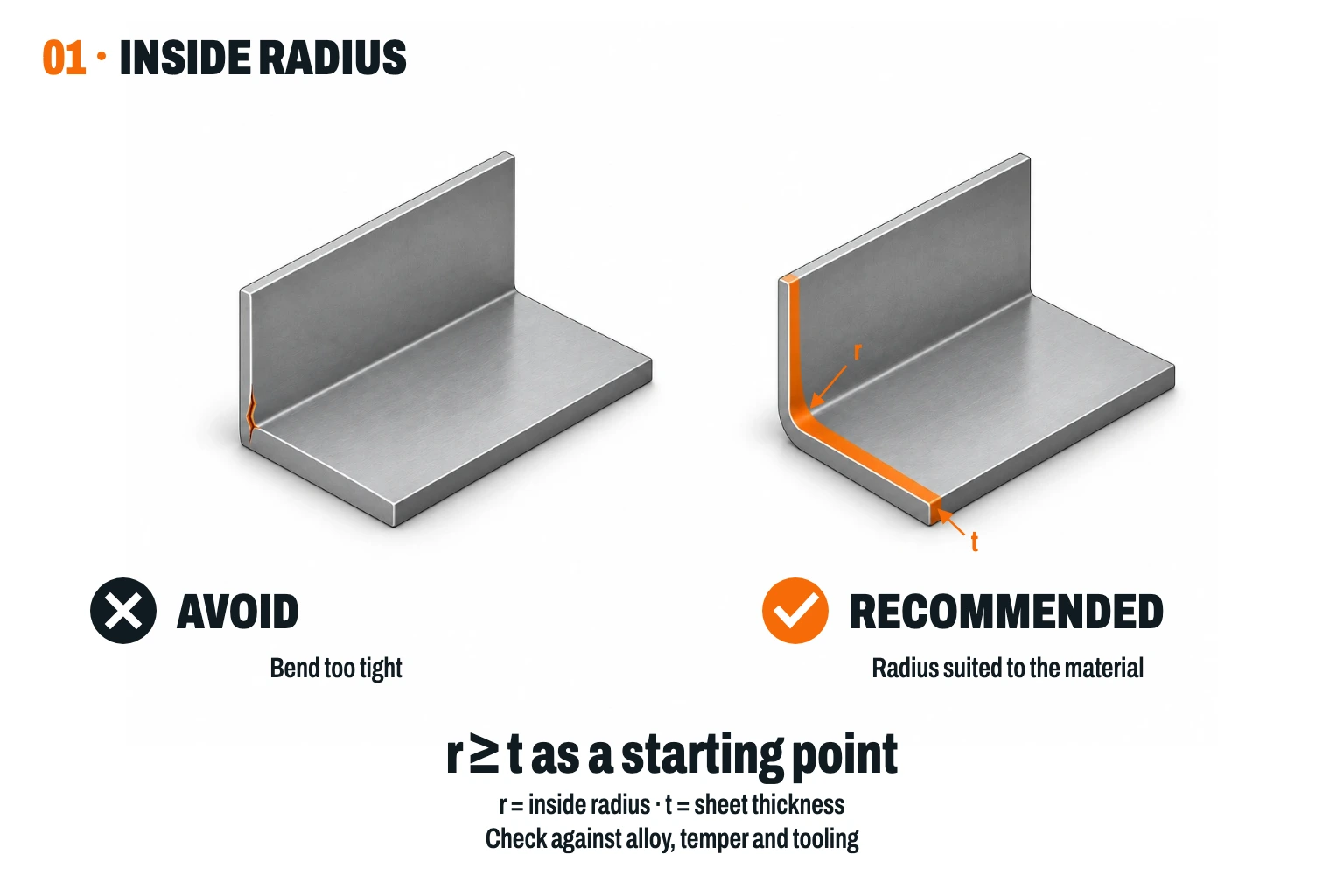
Two sheet metal brackets: very tight bend with a crack versus a rounded bend, with the internal radius highlighted in orange.

01Internal radius

Use an internal fillet radius equal to or greater than the wall thickness and adjust it to the material and tooling. Some alloys and conditions require larger radii; use standard radii whenever possible.

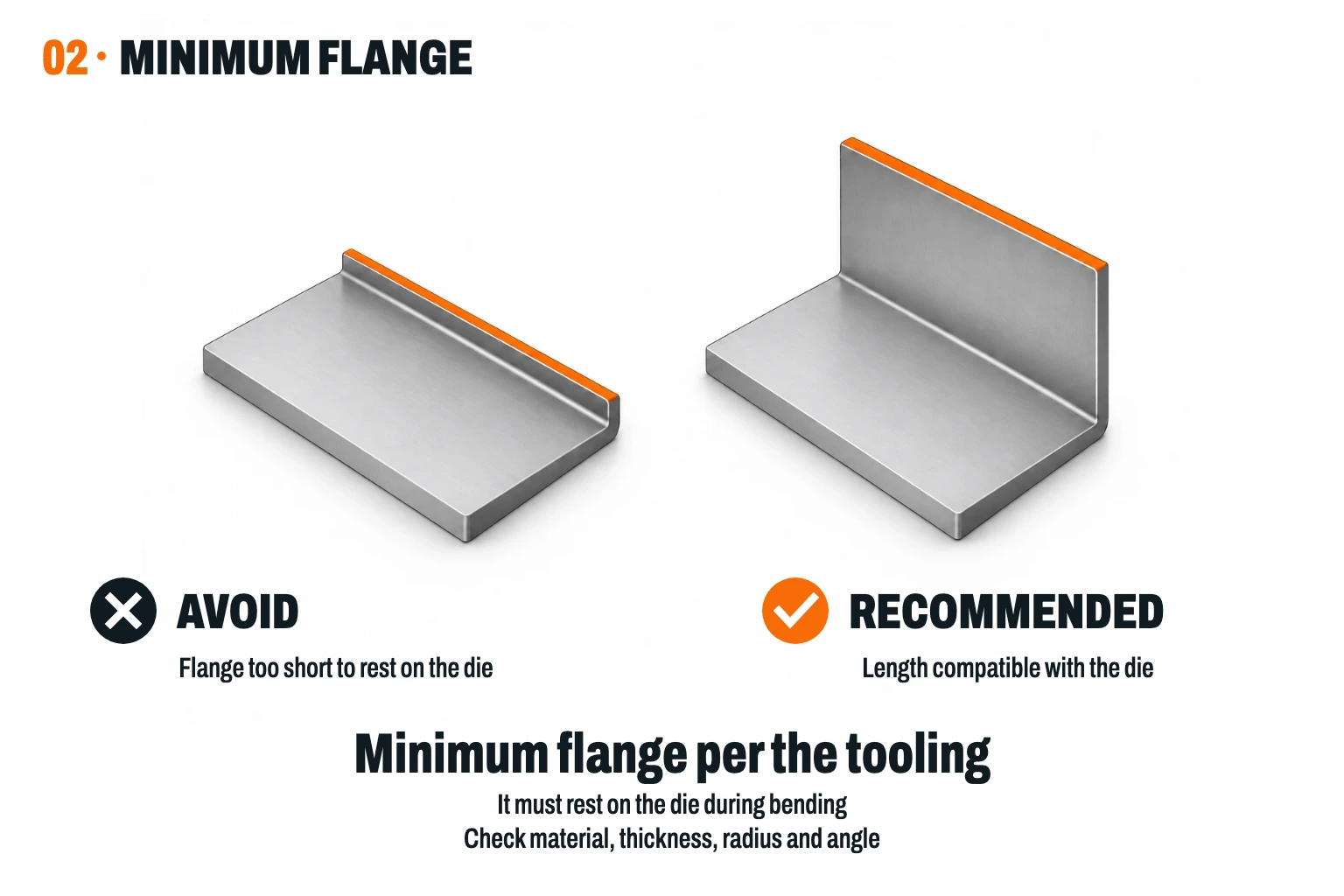
Square with a very short flange facing another with a longer flange; their free edges are highlighted in orange.

02Minimum flange

The flange must have sufficient length to support itself on the die. Confirm the minimum length based on the material, thickness, radius, and angle; four thicknesses are not a universal rule.

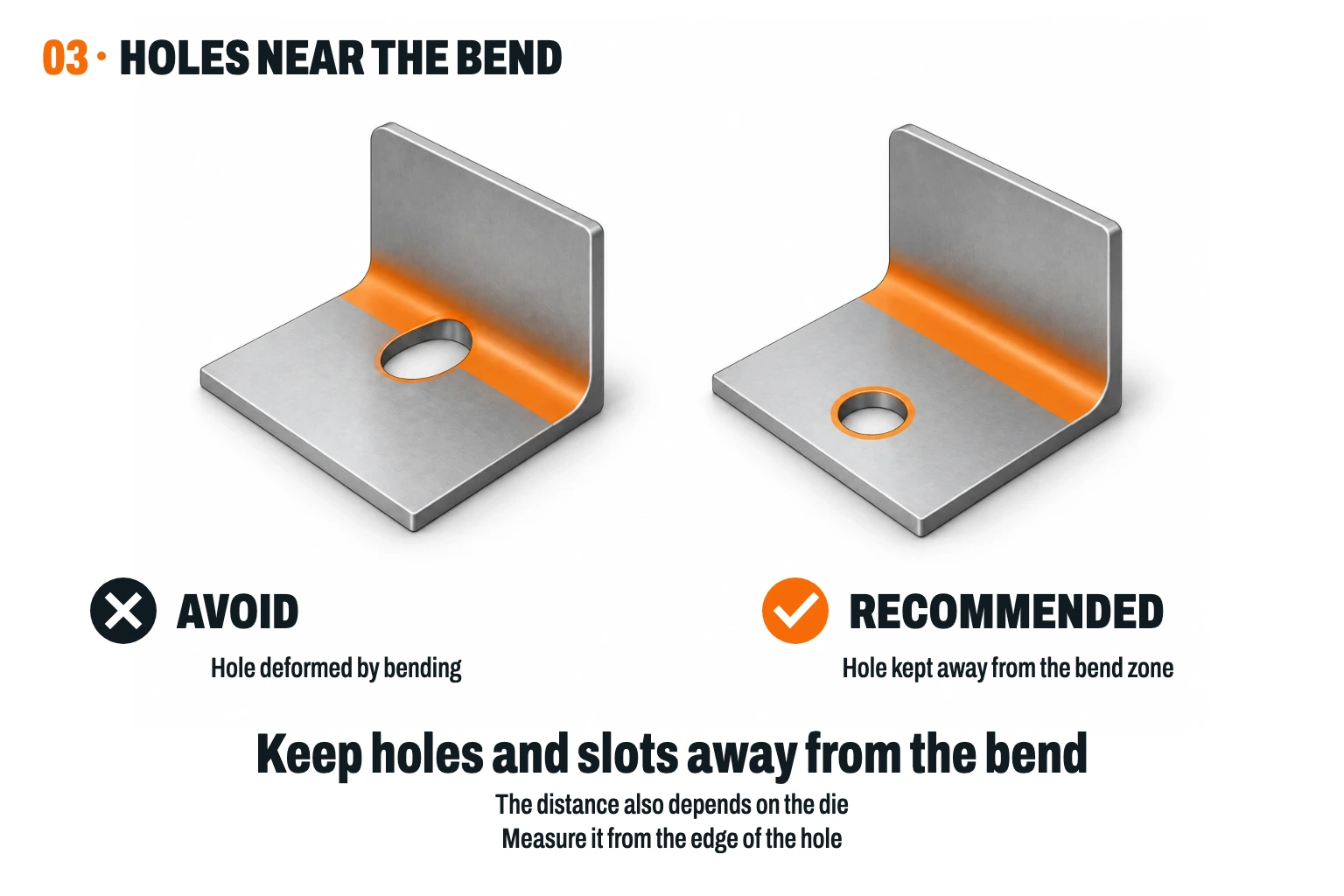
Hole too close to the bend that has become oval, compared to a circular one located further away; the bending zone and edges are highlighted in orange.

03Holes near the bend

Place holes and slots outside the area the die deforms. The spacing depends on the material, thickness, radius, and tool opening, as well as the size of the opening.

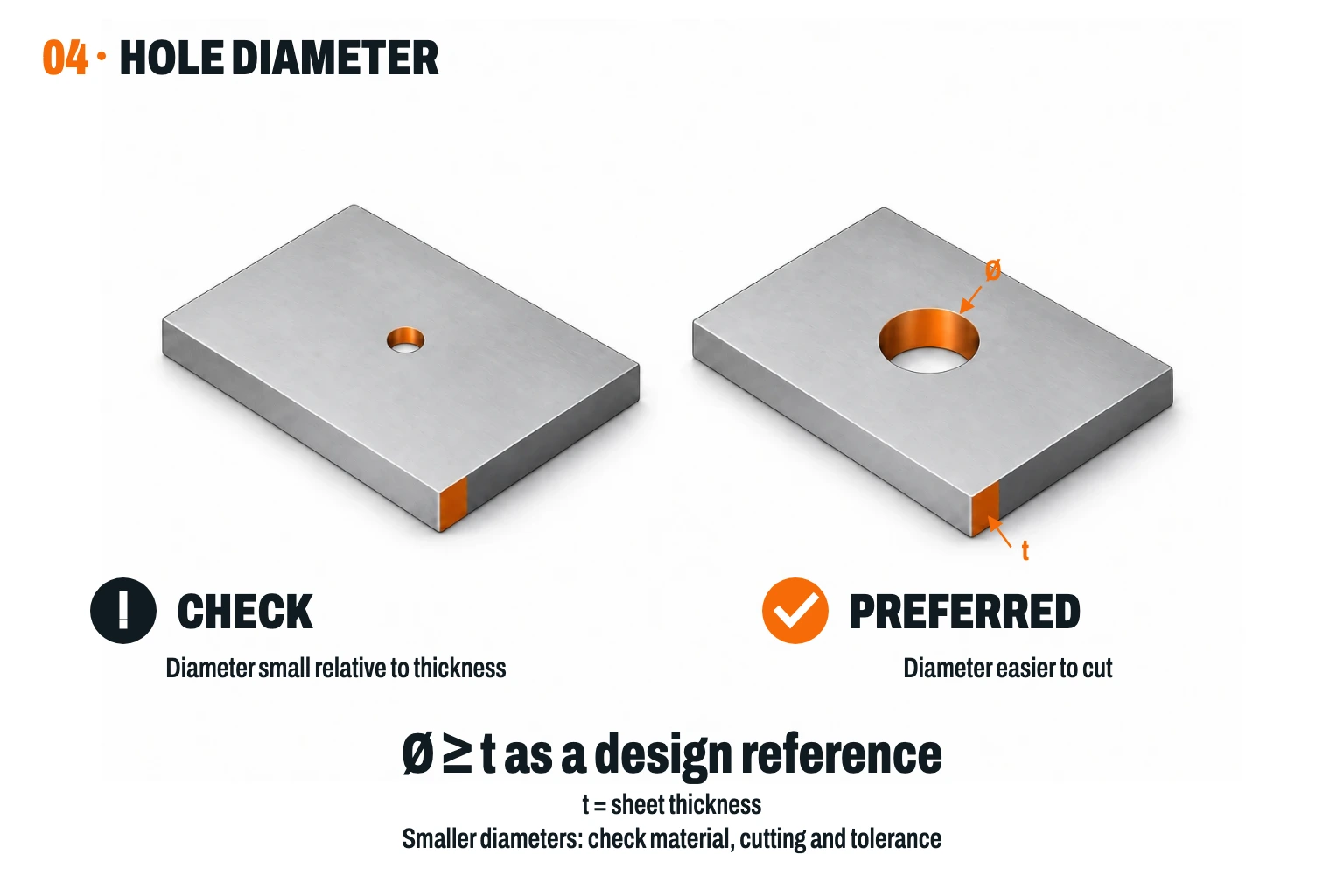
Two sheets of the same thickness with a small hole and a wider one; the hole walls and thickness are marked in orange.

04Hole diameter

A diameter equal to or greater than the thickness is a prudent reference to facilitate cutting. The laser may accept smaller diameters depending on the equipment and material; consult the small or precise details.

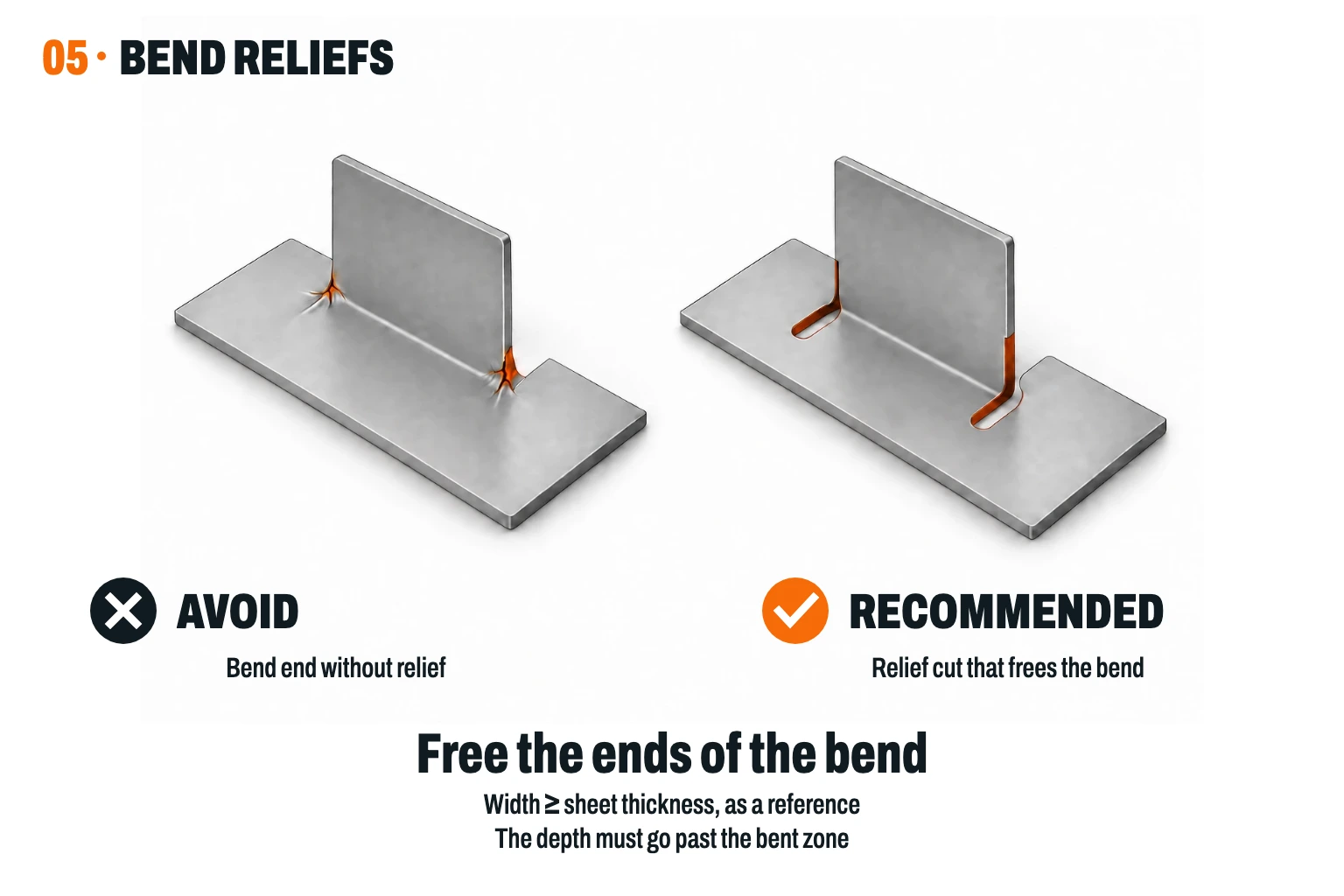
Center tab bent with tears at its ends opposite a tab with two open and rounded relief cuts, highlighted in orange.

05Bend reliefs

When the bend ends next to flat material, add a relief. Take a width equal to or greater than the thickness as reference and extend the base beyond the bent area.

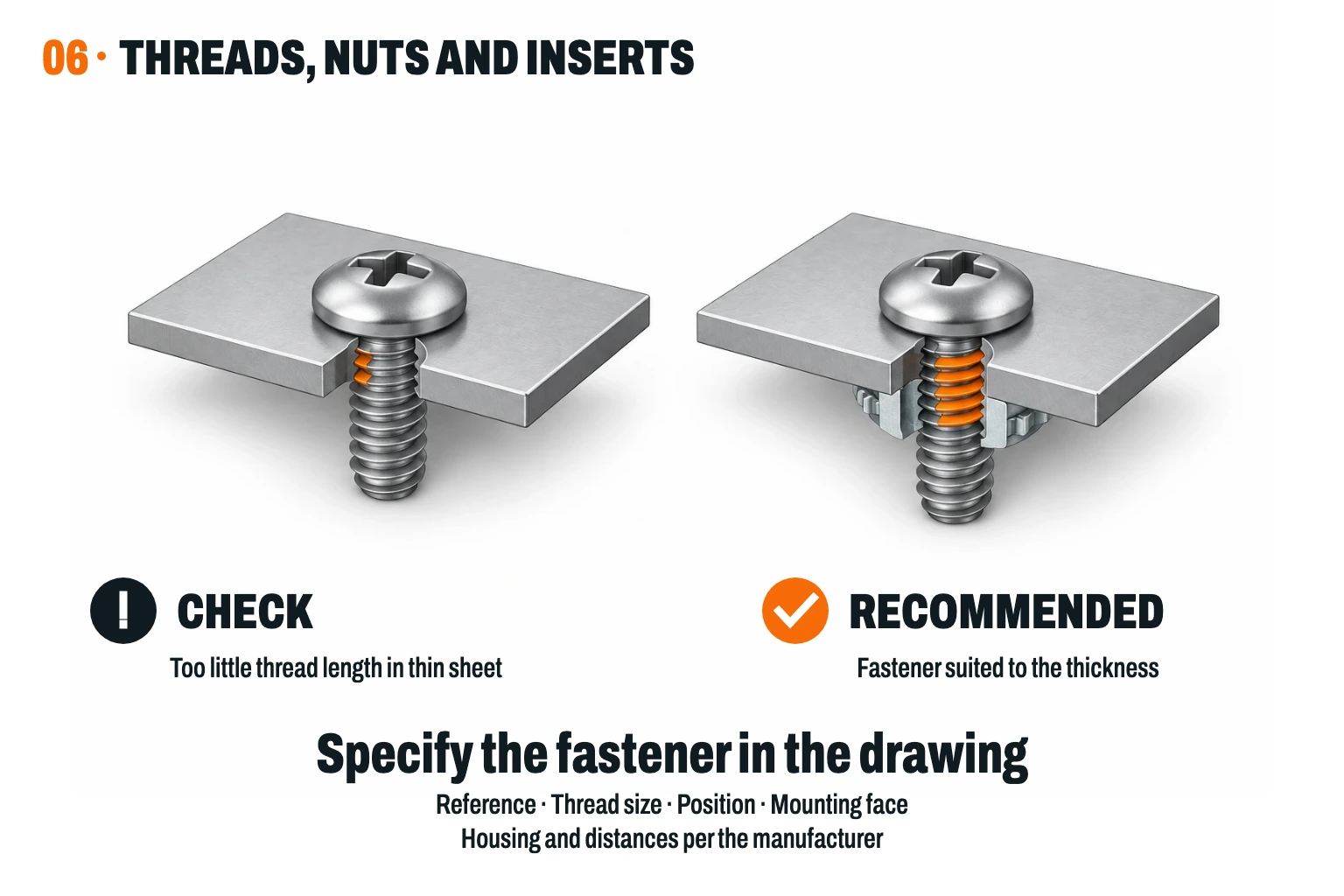
Section of a short direct thread on thin sheet metal opposite a union with a self-locking nut; the thread flanks contact is highlighted in orange.

06Threads, nuts, and inserts

If the sheet metal does not offer sufficient thread length, consider a nut or an insert. Define the reference, the metric, the position, and the mounting face in the PDF drawing assigned to the part.

In this guide
  1. How your part is made
  2. We calculate the flat pattern
  3. The six rules
  4. Tolerances, materials and finishes
  5. Stiffness, assembly and file
  6. Summary and checklist
Proto&Go! · Design guide
Cover of the sheet metal cutting and bending design guide

Free PDF guide

Design guide for sheet metal cutting and bending

Six rules with their dimensions: inside radius, minimum flange, holes near the bend, hole diameter, bend reliefs and fasteners. Plus tolerances, materials and finishes, and which file to send so we can calculate the flat pattern.

English guide

Design guide for CNC machining

Protected against automated submissions by Cloudflare Turnstile. Privacy.

Design guide

06 / Frequently asked questions

Sheet metal cutting and bending,
question by question.

Price and lead time

How much does it cost to cut and bend a sheet metal part?

The price depends on the material, thickness, cut length, bends, finish, and quantity. At Proto&Go! you upload the 3D model and receive a quote with price and lead time within 24 hours.

How can I reduce the cost of a sheet metal part?

Reduce unnecessary bends and cuts and avoid details that require special tools. Ordering multiple units allows you to spread out the setup. Keep tolerances tight only where assembly requires it.

How long does a laser cutting and bending order take?

At Proto&Go! sheet metal parts are manufactured from 8 working days after order confirmation. The lead time depends on the part, finish, and quantity; the specific date appears in the quote.

Can I order a single custom sheet metal part?

Yes. Proto&Go! manufactures from one unit, for both prototypes and short runs. Indicate the quantity you need when requesting the quote.

Tolerances and design

What internal radius should I use for a bent sheet metal part?

This guide uses an internal radius equal to the sheet metal thickness. For example, for 2 mm thickness, a 2 mm radius. The geometry is reviewed along with the material and tools before manufacturing.

What is the minimum flange to bend a 2 mm sheet metal?

The reference for this guide is a minimum flange of 12.5 mm for 2 mm sheet metal. The flange needs sufficient support in the die; a shorter tab requires reviewing the manufacturing.

At what distance from the bend should I place a hole?

Leave the opening outside the area that deforms during bending. For 2 mm sheet metal, this guide takes 12.5 mm as the minimum separation from the bend to the opening. The distance is reviewed with the part geometry.

What distance do two Z-bends require?

According to the table used in this guide, the minimum separation is 25 mm for 2 or 3 mm sheet metal, 40 mm for 4 mm, and 50 mm for 5 or 6 mm. The space allows inserting the part and performing the bends.

What tolerance can I request for laser cutting and bending?

The precision of a cut contour and that of an already bent part are different. Indicate on the drawing the dimensions and angles that affect assembly. The team confirms their feasibility when preparing the quote.

How can I add rigidity to a sheet metal part without increasing thickness?

Adding bent edges can reduce flexing. The result depends on the load direction, supports, and geometry. A tray with bent edges can be more rigid than a flat plate of the same thickness.

What are the relief notches used for in sheet metal bends?

They are small cutouts that leave space to deform the material where a bend ends, helping to prevent tearing, bulging, and deformation of nearby details.

Processes

What is the difference between cutting and bending sheet metal?

Laser cutting produces the outline, holes, and slots of the flat part, while bending folds that sheet metal to form brackets, profiles, trays, or enclosures.

What parts can be manufactured using laser cutting and bending?

Supports, brackets, covers, panels, trays, chassis, and enclosures. This process is especially suitable for parts with uniform wall thickness that combine flat faces and straight bends.

When is it better to manufacture a sheet metal enclosure instead of machining it?

Sheet metal can suit a housing with uniform walls and flat faces. Machining allows variable thicknesses, precise seats and solid shapes. The choice depends on the design, tolerances and quantity.

Does bending leave marks on the sheet metal?

It may leave contact marks from the tools. If a face must remain visible, indicate it on the drawing to evaluate surface protection and the finish.

Can threads, inserts, or welds be added to a sheet metal part?

Yes, depending on the material, thickness, and design. Define the threads, inserts, and welded joints you need on the PDF drawing so they are included in the quote.

Materials and finishes

What metals can I choose for a sheet metal part?

At Proto&Go! you can request carbon steel, stainless steel, aluminum, copper, and brass. The choice depends on weight, environment, part function, and finish.

What sheet metal thicknesses can be cut and bent?

The general range of this guide is from 0.3 to 15 mm, depending on the material. The availability and feasibility of bending are confirmed for the metal, thickness, and geometry of your part.

What finishes does Proto&Go! offer for sheet metal parts?

The same as for machining: anodizing, sandblasting, polishing, bluing, zinc plating, chrome plating, nickel plating, and RAL painting. You can also request the part without a finish. Compatibility depends on the metal.

Can any sheet metal part be anodized?

The anodizing we offer is applied to aluminum. For steel, stainless steel, copper, or brass, you must choose another finish compatible with the metal and usage conditions.

Can I order sheet metal painted in a RAL color?

Yes. Specify the RAL reference and the finish you are looking for when requesting the quote. The image on the screen is for reference.

Files and order

Where can I order laser cutting and sheet metal bending online?

At Proto&Go!, the manufacturing platform of the i-mas group. Upload your 3D model, choose material, finish, and quantity, and receive a quote in 24 hours.

Do I need to send flat sheet metal or the already bent part?

Send the 3D model of the already bent part, with the wall thickness defined. Proto&Go! prepares the necessary development to cut and bend it.

What file format do I need to submit to get a quote for a sheet metal part?

Preferably STEP, with one file per part. SLDPRT, X_T, X_B, IPT, CATPART, PRT, SAT, and 3DM files are also accepted. The Proto&Go! platform does not accept DXF or STL files for sheet metal.

Is it necessary to attach a PDF drawing in addition to the 3D model?

Include it if you need to define threads, inserts, welds, visible faces, or specific tolerances. For a part with no additional requirements, the 3D model allows preparing the quote.

Do you review my design before sheet metal fabrication?

Yes. An engineer reviews manufacturability when preparing the quote. If a bend, an opening, or a dimension requires changes, the adaptation is proposed before fabrication.

Sheet metal cutting and bending

Do you have the file?
Then you almost have the part.

Choose material, finish, and quantity on the platform. You get the quote in 24 hours.

Upload your 3D file to the platform

It opens in a new tab. Accepted formats:

STEPSLDPRTX_T / X_BIPTCATPARTPRTSAT3DM
Get a quote on the platform