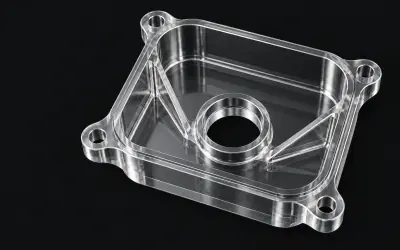
Prototype viewers
Visors to check the operation of a prototype.


Engineering plastics · Custom parts
Transparency with impact resistance. We manufacture machined polycarbonate parts for covers, visors, and product prototypes.
Get your quoteQuote in 24 h · Engineering review
01 / Why choose this material
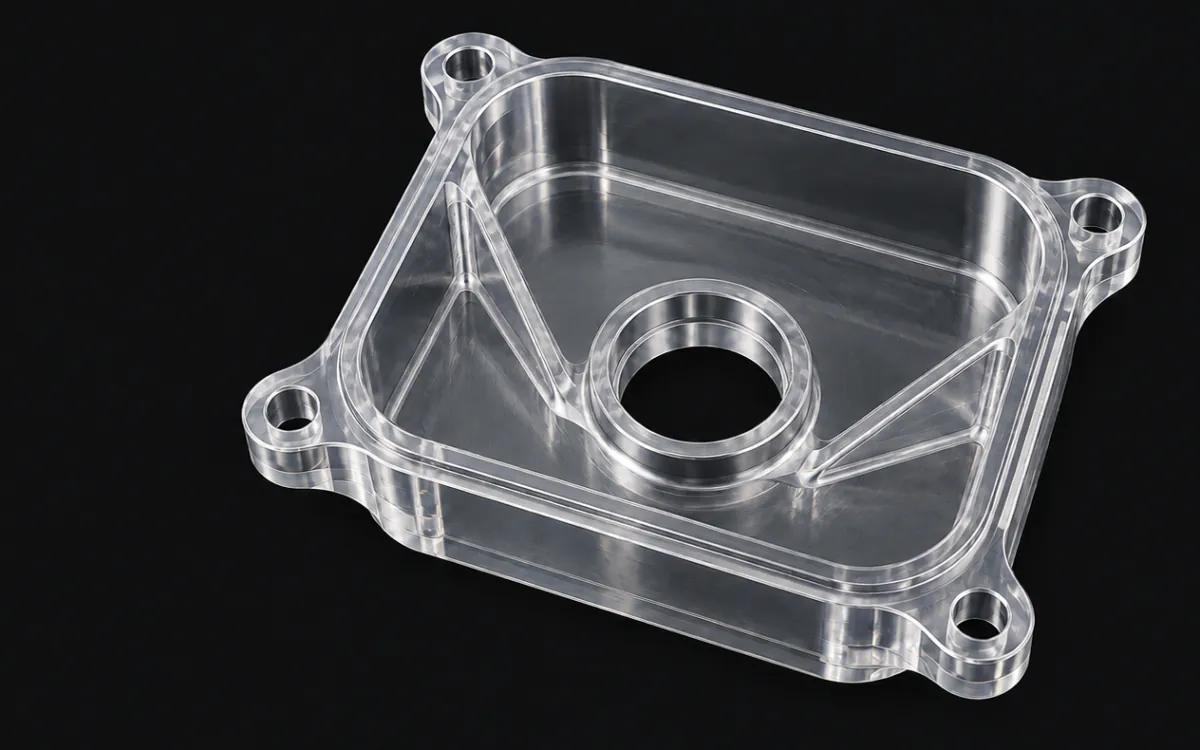
Polycarbonate with good impact resistance. Machining leaves surface marks; polishing allows improving the clarity of optical zones.
Polycarbonate, abbreviated PC, is a tough thermoplastic used in transparent parts. Tools leave marks on the surface, so it is advisable to define which zones need polishing to improve clarity and which are purely functional.
Learn about the CNC machining process ↗Mechanical reference · Proto&Go! material datasheet
Weather resistance requires an appropriate grade or UV protection. Solvents can cause cracks under stress. The additional values are references from the published PDF; the supply grade and testing can change them.
Polycarbonate applications
Visors to check the operation of a prototype.
Covers where the interior of a unit needs to be observed.
Transparent enclosures for form and assembly validation.
Display models with defined polished surfaces.
02 / A choice based on usage
These criteria help define the material, geometry, and working conditions before manufacturing.
01
PC is rated when toughness is important in addition to transparency. A safety protection requires validating the complete design.
02
Request transparent polishing on the viewing faces. Machining alone does not guarantee final optical quality.
03
Confirm UV resistance and cleaning products. Some solvents can cause stress cracking.
Indicate loads, temperature, environment, and appearance needed. If the drawing requires a specific grade, include it in the request.
03 / Finishing also counts
Define visible surfaces and the required result for your part. Requested treatments are included in the quote.
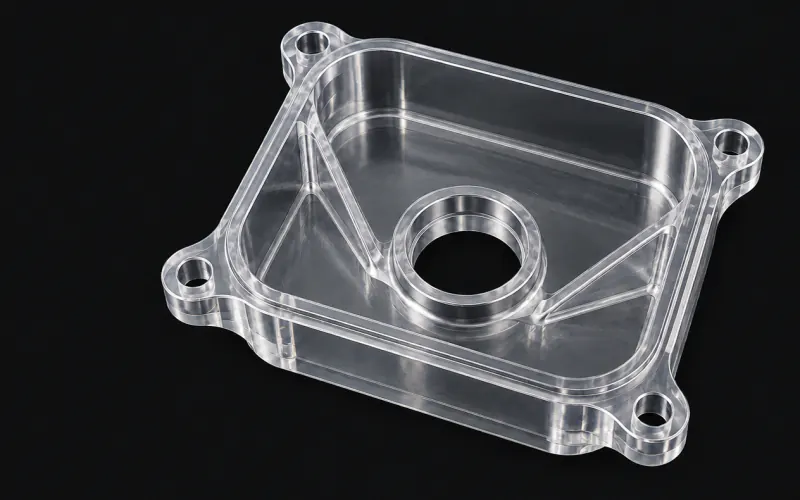
The part retains machining marks. Indicate adjustment surfaces and visible faces on the drawing.
The image could not be loaded. Try a different finish.
Reference images: material, geometry, and surface preparation influence the outcome. Special finishes are quoted upon request.
04 / From design to quote
Milling and turning allow manufacturing polycarbonate parts from a block, plate, or bar. The tool removes material to obtain faces, cavities, drilled holes, and contours according to the design.
Send a 3D model per part in STEP or a native supported format: SLDPRT, X_T, X_B, IPT, CATPART, PRT, SAT, or 3DM. Attach a PDF drawing for threads, inserts, or specific tolerances. STL is accepted only for 3D printing.
Upload your file and request a quoteFor dimensions without a specific tolerance, Proto&Go! applies ISO 2768-m. With a drawing, equivalent tolerances to IT11 can be assessed, depending on the geometry and requested dimensions. Attach the drawing and mark the functional surfaces.
Calculate a tolerance ↗In CNC, setup costs are distributed across the batch units. The final reduction depends on machining time and material.
Parts from 8 working days after confirming the order. The quote specifies the lead time based on geometry, material, finish, and quantity.
How much it costs to manufacture
The cost of CNC machining polycarbonate depends on the geometry, grade, tolerances, finish, and quantity. It includes material, preparation, and machining.
Check the catalog example to compare materials. To know the cost of your design, request a quote with your 3D file.
Frequently asked questions
Properties, applications, and manufacturing: answers to prepare your request.
Transparent polycarbonate with good impact resistance. Machining leaves surface marks; polishing allows improving the clarity of optical areas. Weather resistance requires an appropriate grade or UV protection. Solvents can cause stress cracking. The added values are references from the published PDF; the supply grade and testing can change them.
We can manufacture prototype visors, transparent covers, housings, and validation optical models. CNC machining allows adapting the geometry to your 3D file. Define the loads, the environment, and the finish so we can review the application.
Polycarbonate stands out for its impact resistance; PMMA or acrylic for its clarity and visual appearance. In both, the final transparency depends on the finish. The choice must consider impacts, thickness, and usage environment.
The material is transparent, but machining marks can reduce clarity. Indicate the faces that need transparent polishing and the expected visual result. Not all internal surfaces or geometries can be polished in the same way.
An appropriate grade or UV protection must be chosen. Temperature and cleaning products must also be reviewed, as some agents can cause stress cracking. Weather resistance is not identical in all polycarbonates.
The cost of CNC machining polycarbonate depends on the geometry, grade, tolerances, finish, and quantity. It includes material, preparation, and machining. Upload the 3D file to the Proto&Go! platform to receive a quote with cost and lead time.
For dimensions without a specific tolerance, Proto&Go! applies ISO 2768-m. With a drawing, equivalent tolerances to IT11 can be assessed, depending on the geometry and requested dimensions. Attach the drawing and mark the functional surfaces.
Send a 3D model per part in STEP or a native supported format: SLDPRT, X_T, X_B, IPT, CATPART, PRT, SAT, or 3DM. Attach a PDF drawing for threads, inserts, or specific tolerances. STL is accepted only for 3D printing.
Compare before choosing
Your next part
Upload the 3D file. We review feasibility and send you the quote.
We use our own and third-party cookies to understand how the website is used and which campaigns work. You can accept them all, reject them all or choose which ones; the website works the same either way. Cookie policy.