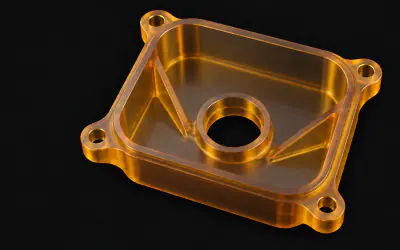
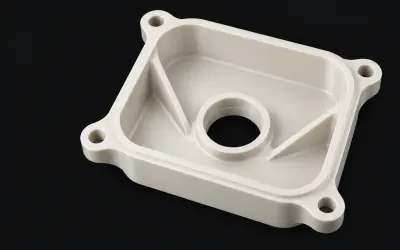
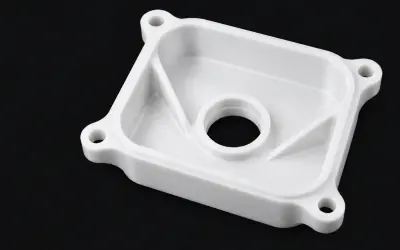
Bearings and gears
Bearings and gears subjected to demanding thermal conditions.


High performance · Custom parts
Components for heat, load, and chemical agents. We manufacture machined PEEK parts for applications requiring high-performance plastic.
Get your quoteQuote in 24 h · Engineering review
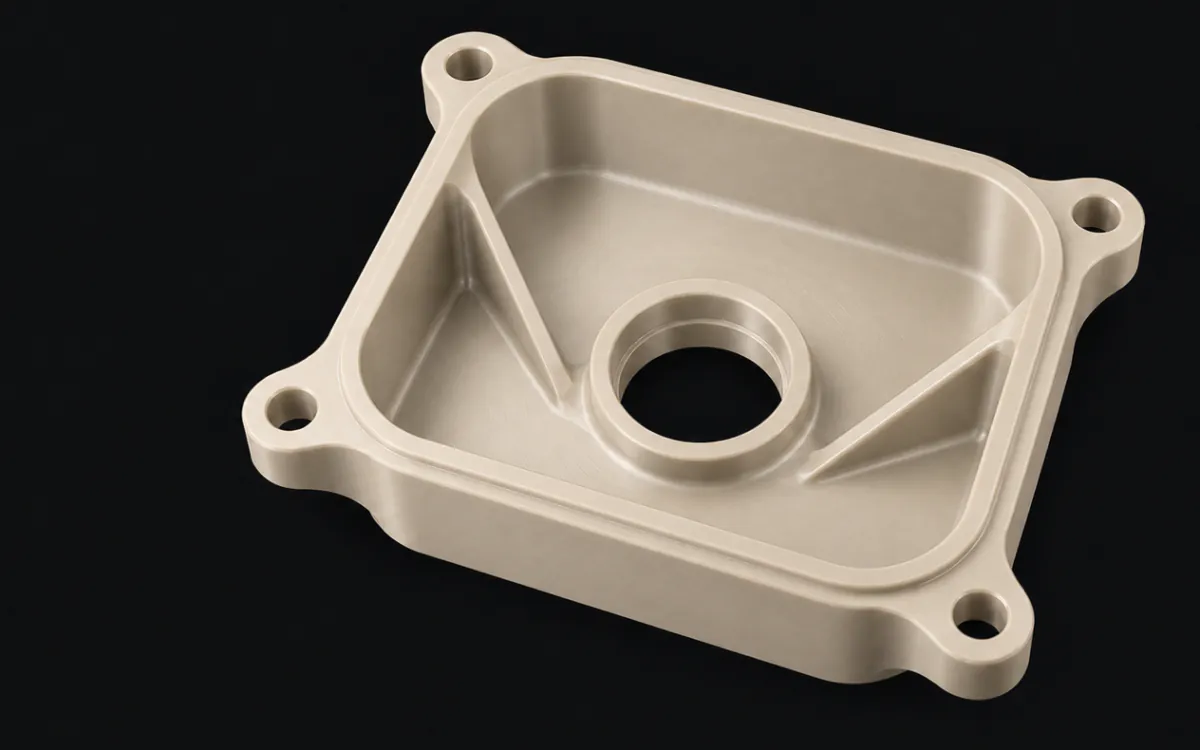
01 / Why choose this material
High-performance thermoplastic for parts subjected to heat, load, and chemical agents. It offers good stability and mechanical resistance in demanding conditions.
PEEK, polyetheretherketone, is a thermoplastic used in parts subjected to demanding conditions. Its selection must meet a specific need for temperature, chemical resistance, or wear. The unreinforced grade and filled compounds have different properties.
Learn about the CNC machining process ↗Mechanical reference · TECAPEEK natural, unreinforced
Reference tensile strength, modulus, and elongation for natural unreinforced TECAPEEK. Density and continuous use are indicative from the catalog. Admissible temperature depends on load and duration; medical contact requires a specific grade and validation.
Property reference: Ensinger · TECAPEEK natural ↗
Applications of PEEK
Bearings and gears subjected to demanding thermal conditions.
Insulators and connectors in grades without conductive loads.
Process components with compatible chemical agents.
Parts for equipment requiring elevated temperature stability.
02 / A choice based on usage
These criteria help define the material, geometry, and working conditions before manufacturing.
01
The continuous use reference does not replace stress verification, exposure time, and geometry.
02
Specify speed, lubrication, and contact surface for bearings and gears.
03
Indicate reinforcements, certifications, or contact requirements. An industrial grade is not equivalent to a validated medical grade.
Indicate loads, temperature, environment, and appearance needed. If the drawing requires a specific grade, include it in the request.
03 / Finishing also counts
Material and process define the surface. These are the key factors for specifying your part's appearance.
The part retains machining marks. Indicate adjustment surfaces and visible faces on the drawing.
For functional surfaces, define roughness and tolerances in the drawing. Feasibility is reviewed based on grade and geometry.
Include the expected appearance and usage conditions in your request to confirm the quote.
04 / From design to quote
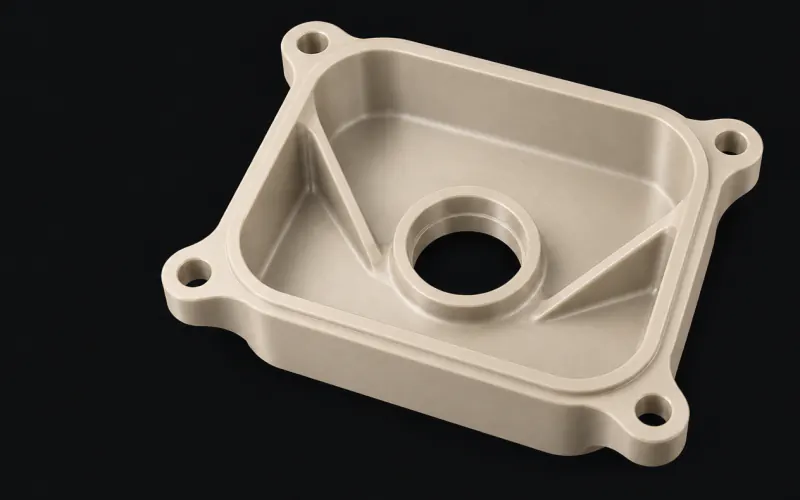
Milling and turning allow manufacturing PEEK parts from a block, plate, or bar. The tool removes material to obtain faces, cavities, drilled holes, and contours according to the design.
Send a 3D model per part in STEP or a native supported format: SLDPRT, X_T, X_B, IPT, CATPART, PRT, SAT, or 3DM. Attach a PDF drawing for threads, inserts, or specific tolerances. STL is accepted only for 3D printing.
Upload your file and request a quoteFor dimensions without a specific tolerance, Proto&Go! applies ISO 2768-m. With a drawing, equivalent tolerances to IT11 can be assessed, depending on the geometry and requested dimensions. Attach the drawing and mark the functional surfaces.
Calculate a tolerance ↗In CNC, setup costs are distributed across the batch units. The final reduction depends on machining time and material.
Parts from 8 working days after confirming the order. The quote specifies the lead time based on geometry, material, finish, and quantity.
How much it costs to manufacture
The price to machine PEEK depends on geometry, grade, tolerances, finish, and quantity. It includes material, preparation, and machining.
Check the catalog example to compare materials. To know the cost of your design, request a quote with your 3D file.
Frequently asked questions
Properties, applications, and manufacturing: answers to prepare your request.
High-performance thermoplastic for parts subjected to heat, load, and chemical agents. It offers good stability and mechanical resistance under demanding conditions. Reference tensile strength, modulus, and elongation for natural TECAPEEK without reinforcement. Density and continuous use are indicative based on the catalog. Admissible temperature depends on load and duration; medical contact requires a specific grade and validation.
We can manufacture bearings and gears, insulators and connectors, process components, and high-temperature equipment parts. CNC machining allows adapting the geometry to your 3D file. Define the loads, the environment, and the finish so we can review the application.
When the service requires a combination of heat, chemical resistance, and load that other plastics in the catalog do not cover. It is advisable to define those requirements before assuming its higher cost. For less demanding applications, compare options like POM or PET.
250 °C is a reference for continuous use of certain grades, not a guarantee for any part and load. Duration, stresses, environment, and supply grade must be checked for the specific design.
No. A medical application requires an identified grade and the corresponding validations for the intended use. The resistance of industrial PEEK does not imply biocompatibility nor authorization for implants. Indicate those requirements before requesting the material.
The price to machine PEEK depends on the geometry, grade, tolerances, finish, and quantity. It includes material, preparation, and machining. Upload the 3D file to the Proto&Go! platform to receive a quote with cost and lead time.
For dimensions without a specific tolerance, Proto&Go! applies ISO 2768-m. With a drawing, equivalent tolerances to IT11 can be assessed, depending on the geometry and requested dimensions. Attach the drawing and mark the functional surfaces.
Send a 3D model per part in STEP or a native supported format: SLDPRT, X_T, X_B, IPT, CATPART, PRT, SAT, or 3DM. Attach a PDF drawing for threads, inserts, or specific tolerances. STL is accepted only for 3D printing.
Compare before choosing
Your next part
Upload the 3D file. We review feasibility and send you the quote.
We use our own and third-party cookies to understand how the website is used and which campaigns work. You can accept them all, reject them all or choose which ones; the website works the same either way. Cookie policy.