Sliding guides
Guides for moving components in machinery.


Engineering plastics · Custom parts
Dimensional stability for parts that guide and slide. We manufacture machined PET components for bushings, rollers, and packaging machinery.
Get your quoteQuote in 24 h · Engineering review
01 / Why choose this material
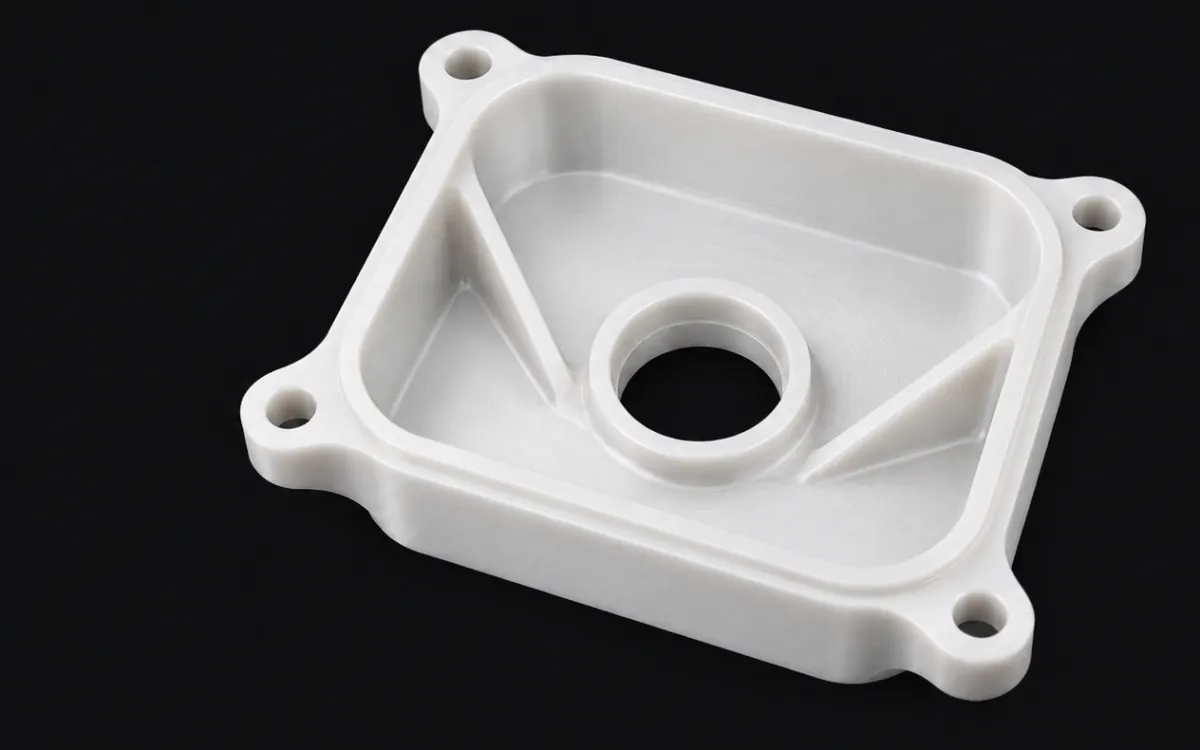
Semi-crystalline and opaque PET for CNC machining, offering good dimensional stability and wear resistance. It is used in guiding elements and mechanical parts.
PET, polyethylene terephthalate, is offered here as semi-crystalline and opaque for CNC machining. Its low moisture absorption and wear resistance make it suitable for guiding elements. It is not the transparent presentation used in many packaging containers.
Learn about the CNC machining process ↗Mechanical reference · Proto&Go! material datasheet
This datasheet corresponds to machinable PET. Amorphous PET for packaging and other transparent products is a different presentation. Check chemical compatibility and hot water compatibility. The added values are references from the published PDF; the supply grade and test results may vary.
PET Applications
Guides for moving components in machinery.
Bushings with defined wear and fit requirements.
Rollers for product transport and positioning.
Packaging equipment parts with compatible contact agents.
02 / A choice based on usage
These criteria help define the material, geometry, and working conditions before manufacturing.
01
Low moisture absorption facilitates maintaining fits, without eliminating thermal expansion or load deformation.
02
For bushings and guides, check load, speed, lubrication, and contact material.
03
Confirm compatibility with cleaning products, hot water, and steam before choosing the grade.
Indicate loads, temperature, environment, and appearance needed. If the drawing requires a specific grade, include it in the request.
03 / Finishing also counts
Material and process define the surface. These are the key factors for specifying your part's appearance.
The part retains machining marks. Indicate adjustment surfaces and visible faces on the drawing.
For functional surfaces, define roughness and tolerances in the drawing. Feasibility is reviewed based on grade and geometry.
Include the expected appearance and usage conditions in your request to confirm the quote.
04 / From design to quote
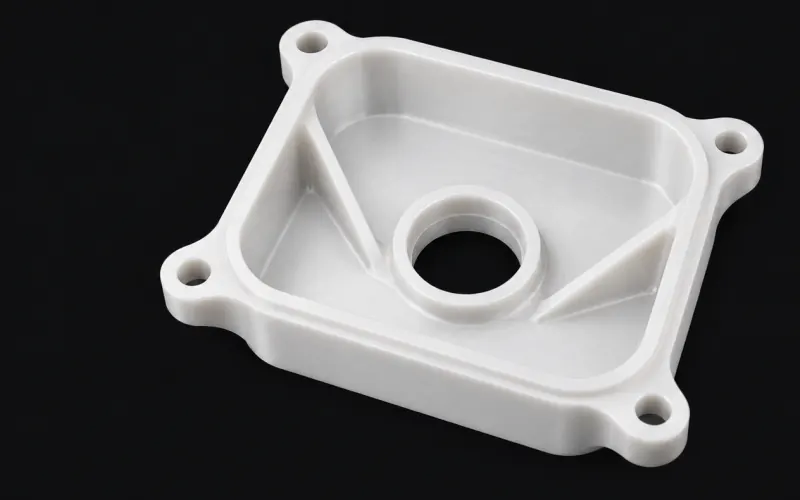
Milling and turning allow manufacturing PET parts from a block, plate, or bar. The tool removes material to obtain faces, cavities, drilled holes, and contours according to the design.
Send a 3D model per part in STEP or a native supported format: SLDPRT, X_T, X_B, IPT, CATPART, PRT, SAT, or 3DM. Attach a PDF drawing for threads, inserts, or specific tolerances. STL is accepted only for 3D printing.
Upload your file and request a quoteFor dimensions without a specific tolerance, Proto&Go! applies ISO 2768-m. With a drawing, equivalent tolerances to IT11 can be assessed, depending on the geometry and requested dimensions. Attach the drawing and mark the functional surfaces.
Calculate a tolerance ↗In CNC, setup costs are distributed across the batch units. The final reduction depends on machining time and material.
Parts from 8 working days after confirming the order. The quote specifies the lead time based on geometry, material, finish, and quantity.
How much it costs to manufacture
The price to machine PET depends on the geometry, the grade, the tolerances, the finish, and the quantity. It includes material, preparation, and machining.
Check the catalog example to compare materials. To know the cost of your design, request a quote with your 3D file.
Frequently asked questions
Properties, applications, and manufacturing: answers to prepare your request.
Semicrystalline and opaque PET for machining, with good dimensional stability and wear resistance. It is used in guiding elements and mechanical parts. This datasheet corresponds to machinable PET. Amorphous PET for packaging and other transparent products is a different presentation. Check chemical compatibility and hot water compatibility. The added values are references from the published PDF; the supply grade and test may vary.
We can manufacture sliding guides, bushings, rollers, and packaging machinery parts. CNC machining allows adapting the geometry to your 3D file. Define the loads, the environment, and the finish so we can review the application.
No. The PET in the catalog for machining is semicrystalline and opaque. The transparent presentations used in packaging are different. If you need a machined transparent part, you can compare polycarbonate and PMMA with the appropriate finish.
PET absorbs less moisture than PA6, which helps dimensional stability. Still, temperature, load, and geometry affect the dimensions. The choice should also consider the toughness and wear the mechanism needs.
PET is used in guiding elements and packaging machinery. If the part will be in contact with food, you must confirm the grade and the corresponding documentation. Also indicate cleaning conditions, especially if they include hot water or steam.
The price to machine PET depends on the geometry, the grade, the tolerances, the finish, and the quantity. It includes material, preparation, and machining. Upload the 3D file to the Proto&Go! platform to receive a quote with cost and lead time.
For dimensions without a specific tolerance, Proto&Go! applies ISO 2768-m. With a drawing, equivalent tolerances to IT11 can be assessed, depending on the geometry and requested dimensions. Attach the drawing and mark the functional surfaces.
Send a 3D model per part in STEP or a native supported format: SLDPRT, X_T, X_B, IPT, CATPART, PRT, SAT, or 3DM. Attach a PDF drawing for threads, inserts, or specific tolerances. STL is accepted only for 3D printing.
Compare before choosing
Your next part
Upload the 3D file. We review feasibility and send you the quote.
We use our own and third-party cookies to understand how the website is used and which campaigns work. You can accept them all, reject them all or choose which ones; the website works the same either way. Cookie policy.