CNC machined prototypes: when they make sense and what they cost
When it is worth machining a prototype instead of printing it, what sets its price, how to make it cheaper without losing function, and what you need to send to order it.
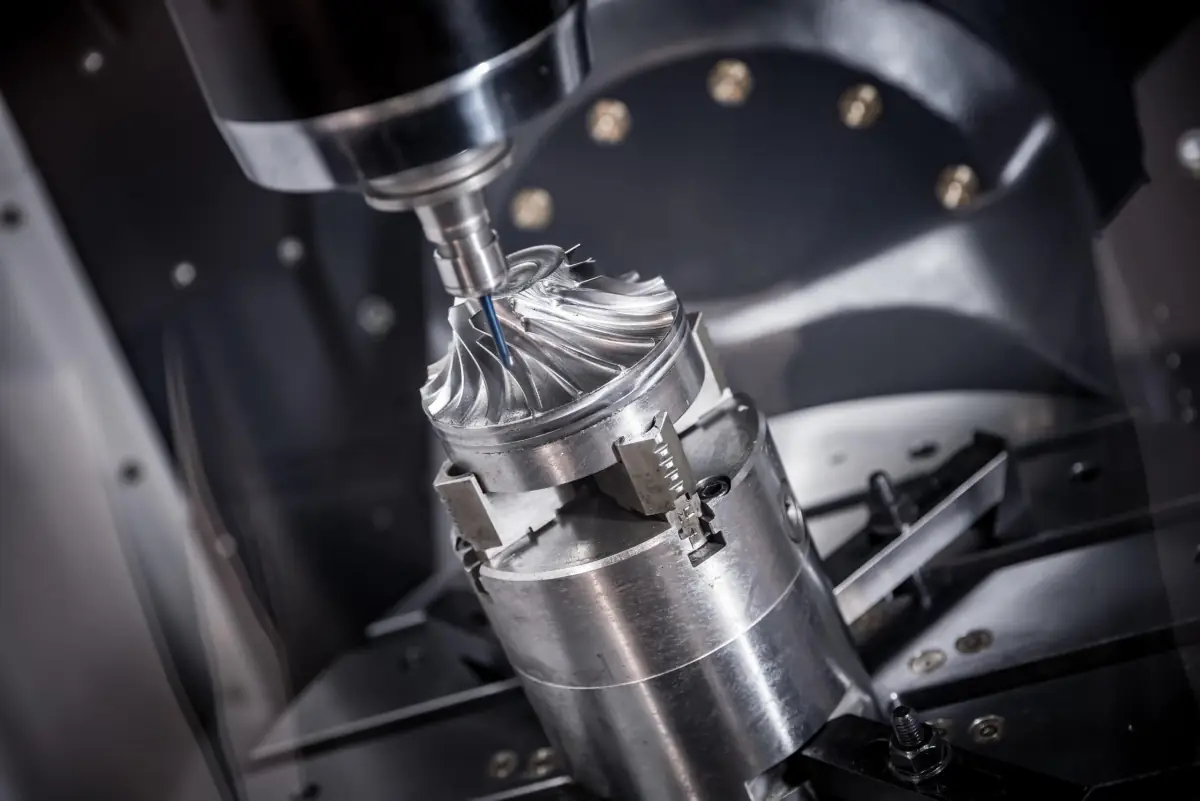
A machined prototype is a part made by CNC machining from a block or bar of the final material: aluminum, steel, stainless steel, or an engineering plastic. It makes sense when the prototype has to really work, that is, withstand load, heat, or friction, fit with other parts to tight tolerances, or validate the material that will go into production. If you only need to check the shape or volume, 3D printing is usually cheaper.
This guide explains when machining pays off, what decides the price, how to bring it down without losing function, how long it takes, and which file to send. If you are still deciding between a prototype to show and one to test, start with functional vs. visual prototypes.
Machine the prototype when what you want to test depends on the material or the tolerance. If it only depends on the shape, print it.
When to machine a prototype
CNC machining is the logical choice in these cases:
- Mechanical or thermal tests. A machined part in 6082 aluminum or PEEK behaves like the production part, because it is the same solid material, with no layers or porosity.
- Fits and assemblies. Bearing seats, shafts, guides, or threads that have to fit the first time. In metal we work to ISO 2768-f (±0.10 mm on a 25 mm dimension) and, where needed, to IT7.
- Validating the production material. If the final part will be in 316L stainless steel or POM, a prototype in that material tells you things a resin cannot.
- Contact or sealing surfaces. An as-machined finish is around Ra 1.6 µm, enough for gaskets and seating faces without grinding.
- A few units of a part that will be made in metal. From 1 unit, with no molds or tooling.
On the other hand, if the prototype is for a photo, a trade show, or an ergonomics check, or it has internal cavities no tool can reach, 3D printing is faster and cheaper.
CNC or 3D printing for the prototype?
The quick comparison, with the figures we work with at Proto&Go!:
| Criterion | CNC machining | MJF 3D printing |
|---|---|---|
| Material | The production one: aluminum, steel, stainless steel, brass, bronze, POM, nylon, PEEK, PTFE… | Polyamides and elastomers: PA12, PA11, PA12 GB, PP, TPA |
| Tolerance | ISO 2768-f in metal; IT7 on functional dimensions | ±0.3 mm up to 100 mm; ±0.3% above that |
| Geometry | Limited by tool access and internal radii | Almost free, with internal cavities and channels |
| Lead time | From 8 working days | From 5 working days |
| Best for | Functional prototypes, fits, tests, and material validation | Form prototypes, housings, and complex geometries |
The full decision, with examples, is in which technology to choose for your first prototype. And if the geometry cannot be machined, take a look at MJF 3D printing.
How much does a machined prototype cost?
There is no price per kilo or per part: the cost comes from machine time and setup. These six factors move it the most:
- Material. Aluminum machines quickly and cheaply; stainless steel and PEEK cost more as raw material and cut more slowly.
- Size of the starting block. You pay for the whole block, not just what remains in the part.
- Number of setups. Every time the part has to be flipped, setup time is added. A part with holes on five faces can come out cheaper on 5 axes than in four 3-axis setups.
- Tolerances. An IT7 dimension needs finishing passes and measurement; putting tight tolerances only where they matter saves a lot.
- Features that need small tools. Very small internal radii, deep pockets, and thin walls force slow cutting.
- Finish. Anodizing, bead blasting, black oxide, or RAL painting are one more process, with their own cost and lead time.
The minimum order is €60 and the minimum manufacturing cost of a CNC part is €46. In the quote you can compare up to three quantities at once to see how much the unit price drops.
The full breakdown, also for 3D printing and vacuum casting, is in how much it costs to make a prototype.
How to make a machined prototype cheaper
- Generous internal radii. As a rule, at least a third of the pocket depth and never below 1 mm. A larger radius allows a larger cutter, which cuts faster.
- Walls thick enough. Below 0.8 mm in metal or 1.5 mm in plastic they vibrate and have to be machined very slowly. We explain it in thin walls in machining.
- Tolerances only where there is a function. Leave the rest at the general tolerance (ISO 2768-f in metal, 2768-m in plastic).
- Standard threads, no deeper than needed. From M3 and up to 3 times the diameter.
- Fewer setups. If you can bring holes and pockets onto one or two faces, the part is made in fewer operations.
Every order is reviewed by an engineer, who lets you know if a feature makes the part more expensive without adding anything. If you want to check it before ordering, use the DFM analysis for machining.
Lead time
The quote arrives in 24 h. Machined parts are ready from 8 working days, plus about 24 h of shipping within Spain. Finishes such as anodizing or painting add a few days, which you will see in the quote. If the deadline matters more than the material, a form prototype in MJF is ready from 5 working days.
Materials for machined prototypes
We work with 21 materials. The most requested for prototypes are:
- Aluminum 6082, 6061, 7075, and 5083: light, quick to machine, and anodizable. It is the default choice for a functional metal prototype.
- Stainless steel 304 and 316L: for food contact, wet environments, or medical use.
- Steel, brass, and bronze: wear parts, shafts, bushings, and connectors.
- Engineering plastics: POM for sliding parts and gears, nylon, PC and PMMA for transparent parts, PEEK for high temperature, and PTFE for low friction.
How to choose between them is in how to choose the material for CNC machining, and the full list is in materials.
What you need to send
- The 3D model in STEP (or in your CAD software's native format). Do not use STL: it is a triangle mesh and is not suitable for programming the machining accurately. How to export it properly: STEP file: what it is and how to prepare it.
- A PDF drawing only if needed: to indicate threads, inserts, specific tolerances, or finishes by area.
- Material, finish, and quantity. You can request several quantities to compare prices.
After the prototype
If the prototype works, the next step depends on how many parts you need. For a few dozen, CNC machining is still cost-effective. For runs of 10 to 300 plastic parts, vacuum casting is usually cheaper. For thousands, injection molding. We explain it step by step in from prototype to pre-series and short run.
Frequently asked questions about machined prototypes
Can a single unit be machined?
Yes. CNC machining needs no molds or tooling, so parts are made from 1 unit. The minimum order is €60 and the minimum manufacturing cost of a CNC part is €46.
Is a machined prototype more expensive than a 3D printed one?
Usually yes, because it starts from a solid block and needs programming and setup. In return, it has the material and tolerance of the production part. If you only want to check the shape, 3D printing is usually cheaper.
How accurate is a machined prototype?
In metal we work to the general tolerance ISO 2768-f, about ±0.10 mm on a 25 mm dimension, and reach IT7 on functional dimensions. In plastics, the general tolerance is ISO 2768-m. Typical as-machined roughness is around Ra 1.6 µm.
How long does it take to receive a machined prototype?
The quote arrives in 24 h and parts are ready from 8 working days, plus about 24 h of shipping within Spain. Finishes such as anodizing add a few days.
Which file format do I need?
A STEP file or your CAD's native format. STL is not suitable for accurate machining. Add a PDF drawing only if there are threads, inserts, or tolerances the model does not include.
Can the prototype be made in the same material as the final part?
Yes, and it is the main reason to machine it. We machine 21 materials, including aluminum, stainless steel, steel, brass, bronze, and engineering plastics such as POM, nylon, PEEK, or PTFE.