Threads in custom parts: metric thread chart, inserts and Helicoil
Metric thread chart from M2 to M12 with pitch and tap drill, and when to use a threaded insert or Helicoil in CNC, MJF 3D printing and vacuum casting.
A metric thread chart gives, for each size, the standard pitch and the drill used before tapping. The quick rule is to subtract the pitch from the diameter: an M6 with a 1 mm pitch is drilled at 5 mm. Below you have the chart from M2 to M12 and, after it, how a thread changes with the process.
A thread is not made the same way in machined aluminium as in a printed nylon part or in cast polyurethane. In CNC machining we cut it directly into the material. In plastic, a metal threaded insert is often the better choice. And when aluminium has to survive many assembly cycles, the answer is usually a Helicoil. Let’s go step by step.
What does the metric thread chart from M2 to M12 say?
The ISO metric thread has a 60° profile and is designated with an M and the nominal diameter in millimetres. If nothing else is stated, it means coarse pitch, the standard one. An M8 is an M8×1.25. If you want a fine pitch, you have to write it: M8×1.
The tap drill leaves the hole slightly larger than the minor diameter of the thread. That way the tap cuts without forcing and the thread ends up at 75-80% of its theoretical height. That is enough: a 100% thread is barely stronger and breaks far more taps.
| Size | Coarse pitch (mm) | Tap drill (mm) | Common fine pitch | Fine-pitch drill (mm) |
|---|---|---|---|---|
| M2 | 0.40 | 1.6 | — | — |
| M2.5 | 0.45 | 2.05 | — | — |
| M3 | 0.50 | 2.5 | — | — |
| M4 | 0.70 | 3.3 | — | — |
| M5 | 0.80 | 4.2 | — | — |
| M6 | 1.00 | 5.0 | M6×0.75 | 5.25 |
| M8 | 1.25 | 6.8 | M8×1 | 7.0 |
| M10 | 1.50 | 8.5 | M10×1.25 | 8.75 |
| M12 | 1.75 | 10.2 | M12×1.5 | 10.5 |
The values follow ISO 261 and common shop practice. If your part has a critical fit, the final reference is the drawing and the standard, not a blog chart.
How do you design a thread for CNC machining?
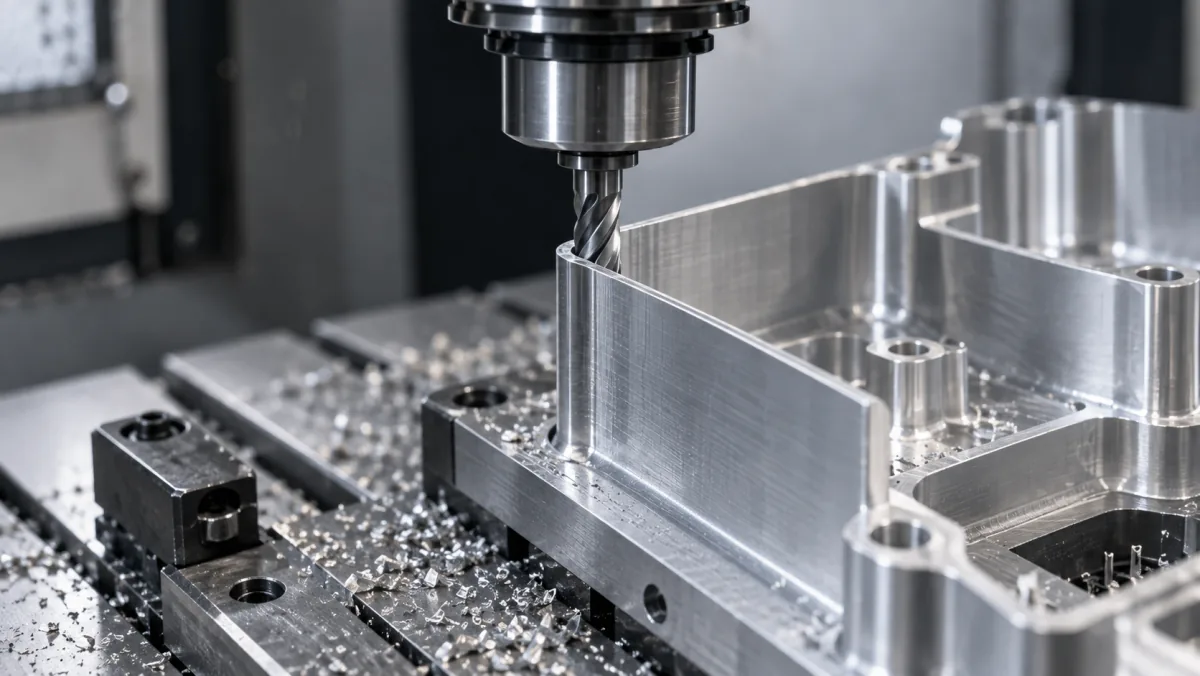
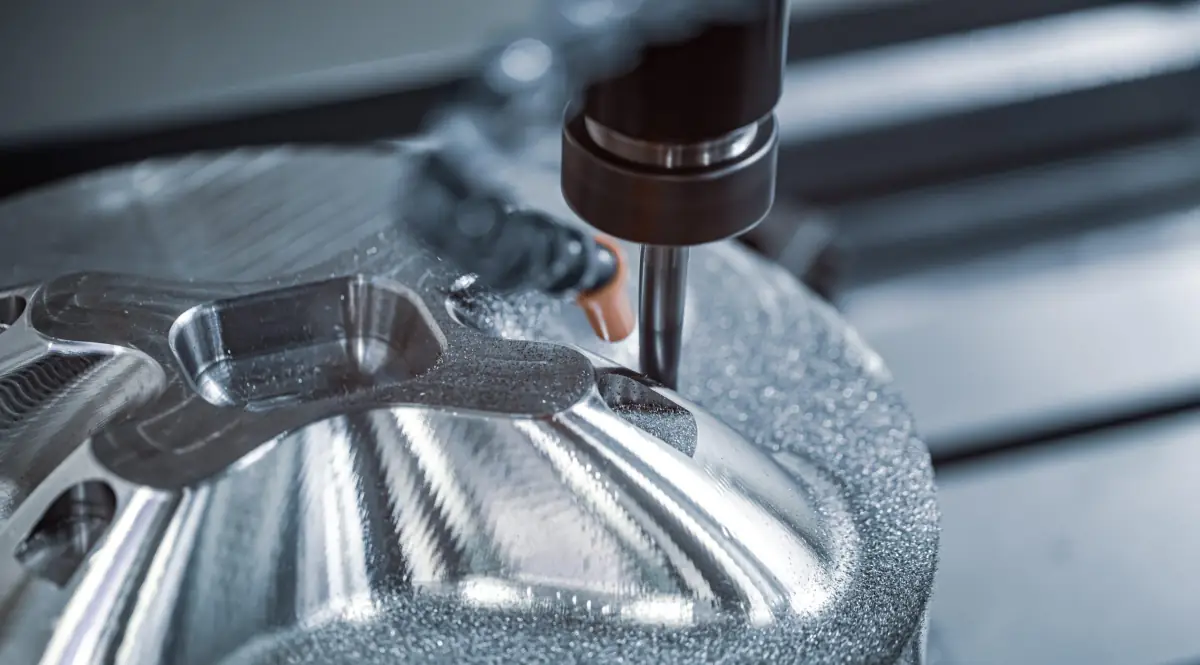
In CNC the thread is made with a tap or a thread mill, after drilling. We machine threads from M3 upwards. Below that, the tap is so thin that it breaks easily and scraps the part.
The first decision is length. A usable thread length of 3 times the diameter is enough. An M6 does not need more than 18 mm of thread. The reason is mechanical: the first turns carry almost all of the screw load. A longer thread is not proportionally stronger, but it is harder to make, because chips clear worse and the tap works harder.
The second is the bottom. A tap has a tapered lead of several turns that do not cut the full profile. So in a blind hole the drilled depth must be greater than the thread. Always leave an unthreaded margin at the bottom. If the usable thread is 12 mm, do not draw a 12 mm hole: draw it deeper and dimension the usable thread separately.
Quick rule. Usable thread = 3 × D at most. Blind hole = usable thread + margin. Whenever you can, make it a through thread: it is cheaper and more reliable.
Finally, the material. In steel or brass the thread itself withstands repeated assembly well. In aluminium too, unless the part will be assembled dozens of times or takes steel screws with high torque. That is where the Helicoil comes in, covered below. If you are unsure about fit tolerances, our guide to tolerances in CNC machining explains which ones to ask for.
Can threads be printed with MJF 3D printing?
Yes, with a clear limit. In MJF 3D printing, threads larger than M6 are printed with their modelled profile. Sintered PA12 reproduces a pitch of 1.25 or more well.
At M6 and below, the profile is so small that the powder texture eats a good part of the thread. It works poorly or strips on the first tightening. There are two ways out:
- Metal insert. The best option if the joint will be taken apart. The pocket is modelled and the insert is fitted after printing.
- Tap afterwards. The hole is printed at tap-drill size and tapped. It works for joints that are assembled only a few times.
In both cases, the hole has no thread in the 3D model. The thread is shown on the PDF drawing.
And in vacuum-cast parts?
In vacuum casting the part is polyurethane. A thread cut directly into PU works, but it wears with repeated assembly. If the joint will be taken apart often, use metal inserts.
Inserts can be placed in the mould before casting, so they end up embedded in the part, or fitted afterwards. It depends on the insert and the polyurethane. Either way, keep material around it: an insert next to a thin edge transfers the load to a wall that cannot take it.
Threaded insert or Helicoil: which one to choose?
Both give you a metal thread inside a softer material. What changes is how they are held.
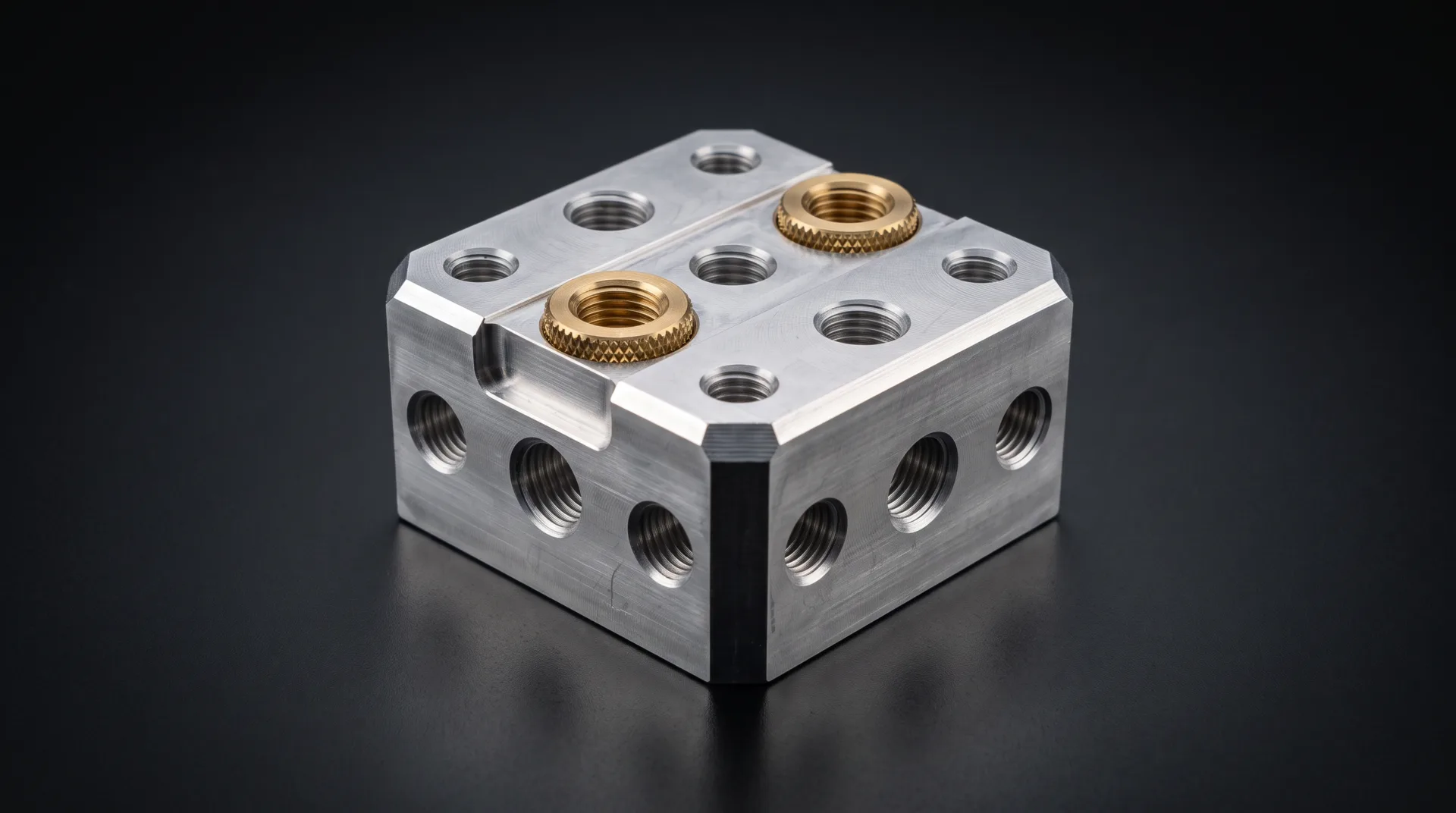
A threaded insert is a bush, usually brass, with an internal thread and knurls or fins on the outside. In plastic it is installed hot: it is heated, melts the surrounding plastic and locks in place as it cools. There are also self-tapping inserts, screwed into a plain hole where they cut their own seat.
A Helicoil is a coil of stainless steel wire with a diamond cross-section. The hole is tapped with a special tap, somewhat larger than the standard one, and the coil is screwed in. The screw works against steel, and the coil spreads the load over more aluminium. Helicoil is a brand; the generic name is wire thread insert.
| Case | Best option | Why |
|---|---|---|
| Printed plastic (PA12, PA11) | Brass heat-set insert | Anchors in melted plastic and survives many assemblies |
| Cast polyurethane | Embedded or post-fitted insert | A thread directly in PU wears out |
| Aluminium, repeated assembly | Helicoil | The screw works against steel and does not strip the thread |
| Aluminium, single assembly | Direct thread | Good enough and cheaper |
| Damaged thread in metal | Repair Helicoil | Restores the original size without changing the screw |
| Steel or brass | Direct thread | The material is already as hard as the screw |
One design detail: a Helicoil needs a larger hole than the standard thread. For an M6 with Helicoil, the hole is drilled at about 6.3 mm and tapped with a dedicated tap. If you draw it at 5 mm in the 3D model, that is fine: what matters is that the drawing says «M6 with Helicoil» and the length. We adjust the hole.
How do you specify threads when ordering a part?
On a PDF drawing. The 3D model does not state the thread size: a 5 mm hole can be a clearance hole, a seat or an untapped M6. That is why, in the STEP file, you draw a plain hole and mark the thread on the drawing.
You do not need a full drawing. A PDF dimensioning those points is enough:
- Thread size, and the pitch if it is not the standard one (M8×1).
- Usable thread length, separate from the hole depth.
- Insert, if any: type, part number and how it is installed.
- Number of identical threads, so nobody has to count them in the 3D model.
If you upload a part with holes that look like threads and there is no drawing, we ask before closing the quote. Better to lose an hour than to make a part with plain holes.
Frequently asked questions about metric threads
What drill size do I need to tap an M10 thread?
For a standard-pitch M10 (1.5 mm), 8.5 mm. For fine-pitch M10×1.25, 8.75 mm. The rule is diameter minus pitch.
What drill is used for an M6 thread?
A 5 mm drill for M6 with a 1 mm pitch. For M6×0.75, 5.25 mm. With a Helicoil, the hole goes up to about 6.3 mm.
How do I identify a metric thread?
Measure the outside diameter of the screw with a caliper: that gives the size. Then measure the pitch with a thread gauge, or count the turns over 10 mm and divide.
What is the smallest thread you can machine?
We machine threads from M3. For smaller sizes in plastic, we suggest an insert or hand tapping afterwards.
Is a threaded insert or a Helicoil better?
In plastic, a brass insert. In aluminium that is assembled and taken apart often, a Helicoil. In steel or brass, a direct thread is enough.
Get your quote with Proto&Go!
If your part has threads or inserts, upload it with the PDF drawing. We check every thread before quoting and tell you whether an insert, a Helicoil or a direct thread makes more sense. You get the quote in 24 hours, engineering review included.