POM or PA6 for guides and bushings
POM does not absorb moisture and maintains its dimensions: it is the option for precision mechanisms. PA6 withstands impacts better, but changes size with humidity. PET falls in between, stable and wear-resistant.


Engineering tool · 33 materials from the catalog
Choose two or three materials and compare them side by side: how they are manufactured, what they withstand, how much they weigh, and what finishes they accept.
| Property | 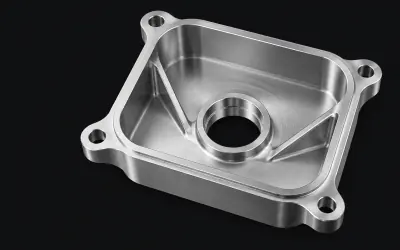 AluminumMetal | 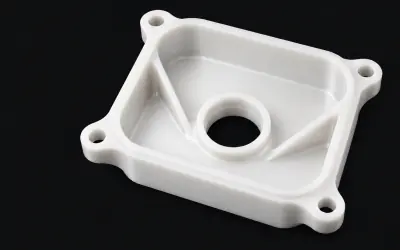 POM · AcetalEngineering plastic | 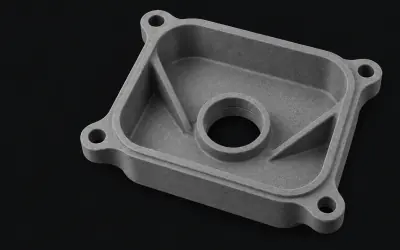 PA12 · Nylon MJF3D printing |
|---|---|---|---|
| Manufactured with | CNC machining Sheet metal cutting and bending | CNC machining | MJF 3D printing |
| In one sentence | A light, easy-to-machine metal with a good strength-to-weight ratio. The alloy and treatment are chosen for the part’s function. | Rigid and stable plastic, with low moisture absorption and good sliding behavior. Suitable for mechanisms and precision parts. | Polyamide for Multi Jet Fusion 3D printing, suitable for functional prototypes and end-use components. Allows complex geometries without dedicated supports. |
| Density | 2.71 g/cm³ | 1.41–1.43 g/cm³ | 1.01 g/cm³ |
| Key strengths |
|
|
|
| Mechanical properties | Elastic modulus70 GPa Tensile strength · AL6082 sample338 MPa Hardness · AL6082 sample104 HB | Tensile strength60 MPa Flexural modulus2.8 GPa Hardness85 Shore D | Tensile strength · ref.48 MPa |
| Thermal and other properties | Melting point · ref. 6082575–650 °C | No data in datasheet | HDT · 0.45 MPa175 °C Surface finishMatte · grainy |
| Finishes | Anodizing · Sandblasting · Nickel plating · Painting | Depending on the part | Black dyeing |
| Applications | Machine components · Automotive · Aviation · Industrial parts | Gears · Bushings and guides · Rollers · Precision parts | Functional housings · Clips and ducts · Assembly fixtures · Complex geometry parts |
| Datasheet and data | Full datasheetAluminum 2024 · PDFAluminum 7075 · PDFAluminum 6082 · PDFAluminum 6061 · PDFAluminum 5083 · PDFIndicative values · AL6082 sample from the Proto&Go! PDFDensity, modulus, and melting point are indicative for aluminum 6082. Tensile strength and hardness correspond to the sample in the Proto&Go! PDF, not a guaranteed minimum. The alloy, heat treatment, and supply format change the properties; the melting point is not the admissible working temperature. | Full datasheetPOM · PDFMechanical reference · Proto&Go! material datasheetDelrin is a brand of POM-H, not a synonym for all POMs. For chemical agents, check concentration and temperature; conductive variants are not insulators. Added values are references from the published PDF; the supply grade and test may vary them. | Full datasheetHP · PA12Reference · HP 3D HR PA 12Reference: HP 3D HR PA 12. The 175 °C corresponds to heat deflection temperature (HDT) at 0.45 MPa; at 1.82 MPa it is 95 °C. These are not continuous use temperatures. |
01 / Weight
Enter the net volume provided by the CAD and compare the grams of each selected material.
Enter a number greater than zero, using a comma or a point for decimals.
Weight = volume × density. Inserts and coatings are not included.
02 / Common questions
Each button loads the materials into the table above.
POM does not absorb moisture and maintains its dimensions: it is the option for precision mechanisms. PA6 withstands impacts better, but changes size with humidity. PET falls in between, stable and wear-resistant.
Three plastics, three processes: PA12 is 3D printed, ABS is machined, and polyurethane is vacuum cast in a silicone mold. PU mimics ABS in stiffness and appearance, but if the specification says ABS, it is ABS.
TPA is 3D printed without a mold and delivers a functional flexible part in days. Flexible polyurethanes for vacuum casting are formulated to the hardness you request, also available in transparent. Compare Shore hardness, recovery, and quantity.
At equal volume, aluminum weighs a third as much as steel and machines faster. Stainless steel wins with humidity or aggressive cleaning; carbon steel, for shafts and bolts with heat treatment.
03 / Frequently asked questions
Six short answers. The rest, in the frequently asked questions.
View all questionsThe 33 in the catalog: metals and engineering plastics for CNC machining, polyamides, PP, TPA and SLA resins for 3D printing, and polyurethanes for vacuum casting. Two or three at a time.
It depends on what kind of strength: tensile, stiffness, impact, wear, or temperature are different things. The table separates them so you can compare the one that matters for your part.
They are from the technical datasheets, with their grade and test. They serve for comparison; the manufactured part depends on the specific alloy or formulation, the process, and the finish.
No. The HDT is a deformation test under load, not the maximum service temperature nor the melting temperature. If the part will work hot, tell us how hot and for how long.
No. The price depends on the geometry, quantity, and finish. On the materials page there is an example with the same part in each material, and with your 3D model you get a quote in 24 hours.
Yes, if you enter the net material volume that the CAD gives you. The bounding-box volume doesn't count.
04 / Catalog
Properties, alloys or formulations, finishes and applications for each material.
Explore materials by processDesign ready?
Upload your 3D model to the Proto&Go! platform, choose process, material, finish, and quantity. You'll receive the quote in 24 hours.
It opens in a new tab. Accepted formats:
We use our own and third-party cookies to understand how the website is used and which campaigns work. You can accept them all, reject them all or choose which ones; the website works the same either way. Cookie policy.