Build volume.
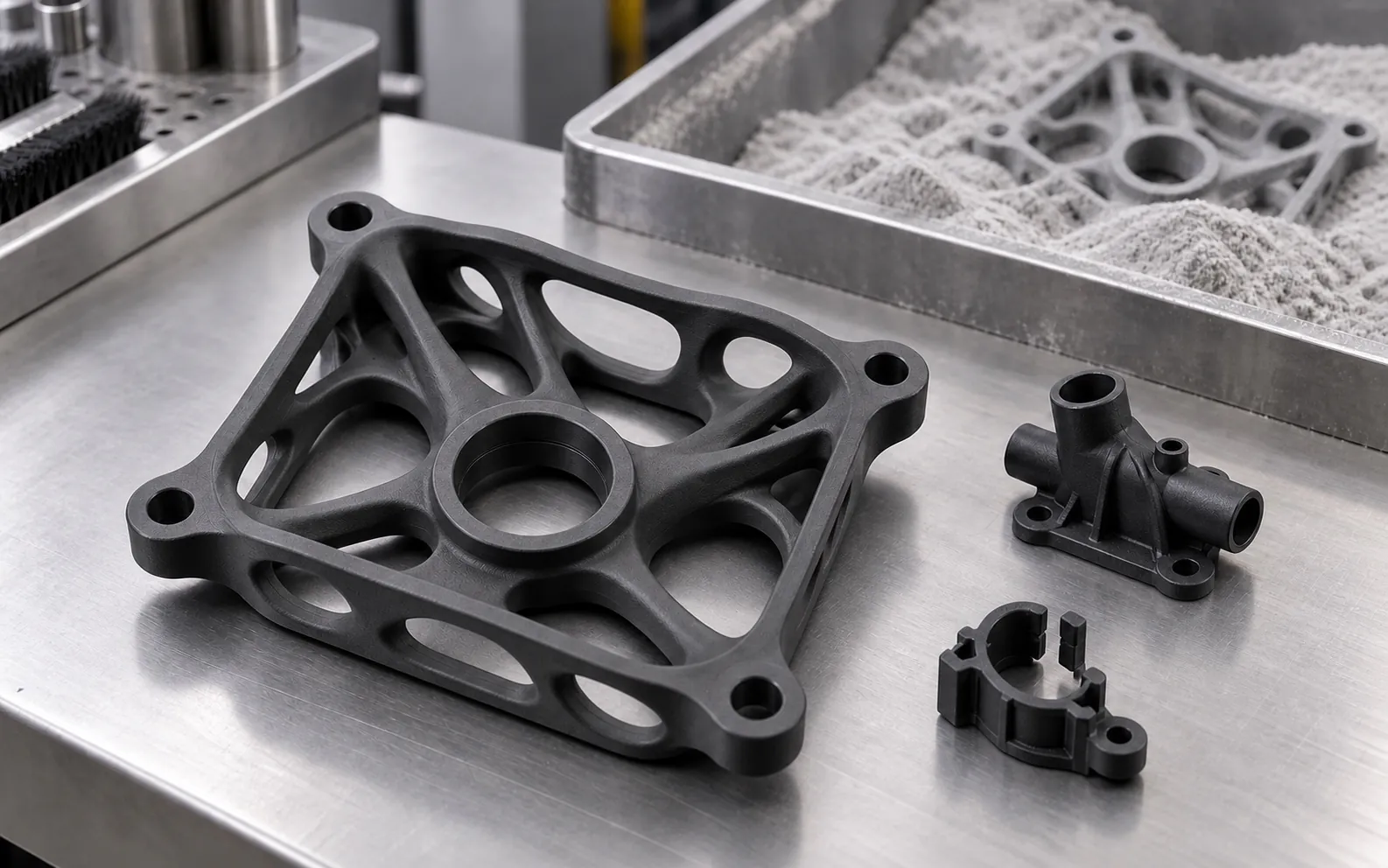
What fits in the machine. Several small parts are printed together in the same build unit.


3D printing · HP Multi Jet Fusion
We print with HP Multi Jet Fusion in PA12, PA11, PA12 GB, PP and flexible TPA. From a single unit and without molds, with a quote in 24 hours and parts from 5 working days.
01 / What MJF is
Multi Jet Fusion (MJF) is an HP 3D printing technology that builds plastic parts from powder. On each layer, a printhead marks where the part goes with a fusing agent and an infrared lamp fuses those areas. The loose powder supports the part, so it needs no supports.
Step by step
02 / Materials
All five are printed on the same machine and with the same design rules. What changes is the stiffness, how far they stretch before breaking and how much heat they withstand.
| Material | Density | Tensile strength | Elongation | Temperature* | Finish | Purpose |
|---|---|---|---|---|---|---|
| PA12 | 1.01 g/cm³ | 48 MPa | 20 % | 95 °C | Natural gray or dyed black | The starting point: housings, brackets, ducts and assembly fixtures. PA12 datasheet |
| PA11 | 1.04 g/cm³ | 50 MPa | 50 % | 50 °C | Natural gray or dyed black | Bends before it breaks: clips, snap fits, living hinges and parts that take impacts. PA11 datasheet |
| PA12 GB | 1.30 g/cm³ | 30 MPa | 10 % | 114 °C | Natural light gray or dyed black | With 40% glass beads: stiffer and no warping. Jigs, gauges and brackets near motors. PA12 GB datasheet |
| PP | 0.89 g/cm³ | 30 MPa | 20 % | 60 °C | Natural gray (cannot be dyed) | The lightest. Watertight and chemical-resistant: tanks, ducts and prototypes of injection-molded PP parts. PP datasheet |
| TPA 90A | 1.0–1.1 g/cm³ | 90 Shore A elastomer: it bends, compresses and recovers its shape | Natural gray | Bellows, seals, grips, dampers and footwear prototypes. TPA datasheet | ||
Reference values from the powder manufacturers (HP; for TPA, Evonik), measured on test specimens. *Heat deflection temperature (HDT) at 1.82 MPa: this is not the continuous service temperature. In the real part, the design and orientation have an influence. Not sure which one to choose? The material selector tells you in two steps.
03 / Size and tolerance
The build unit measures 380 × 284 × 380 mm and we recommend staying within 356 × 280 × 356 mm. The reference tolerance is ±0.3 mm up to 100 mm and ±0.3% above that: on a 200 mm dimension, ±0.6 mm. Larger parts are studied split into sections.
What fits in the machine. Several small parts are printed together in the same build unit.
Leave a margin from the walls of the build unit. If your part gets close to the maximum, we check it when preparing the quote.
If a dimension has to fit another part, mark it on the drawing and we review it before manufacturing.
Tolerances by processOpaque, slightly grainy surface. Small details are softened by bead blasting.
Finishes by process04 / Design
These are starting points for PA12, not universal minimums. An engineer reviews every part before manufacturing and tells you if something will not come out well.
| Rule | Reference | Why |
|---|---|---|
| Wall thickness | 1–1,5 mm | For small walls. If the wall is tall, long or load-bearing, more thickness or ribs. |
| Hollow parts | 2–3 mm wall · 2 outlets Ø5 mm | Hollowing makes the part lighter, but a closed cavity stays full of powder. Outlets work best on opposite sides. |
| Holes | Ø2 mm or more | Long ducts need a larger diameter or access points for cleaning. To fit a pin, the hole is drilled or reamed afterwards. |
| Threads | Larger than M6 | They are printed with their profile modeled. For M6 and smaller, a metal insert or tapping afterwards is better. |
| Text and logos | 2.5 mm · 0.5 mm stroke · 1 mm relief | Below that, bead blasting rounds the edges and the text becomes hard to read. |
The six full rules, with sketches and when to choose PA12 or TPA, are in the 3D printing design guide (free PDF). To learn more about the process: how MJF works and when to choose it and what post-processing a printed part needs.
05 / MJF, SLS, SLA or CNC
MJF is the option for plastic parts that have to work: withstand loads, impacts or heat. If the part is for showing, SLA. If it needs metal or tight fits, machining.
| Process | How it works | Best for | Keep in mind |
|---|---|---|---|
| MJF | Fusing agent and infrared on polyamide, PP or TPA powder. No supports. | Functional parts, clips, housings, ducts and series without a mold. | Opaque, grainy surface, in gray or black. Tolerance ±0.3 mm. |
| SLS | A laser traces each cross-section and sinters the powder. Also without supports. | The same kind of part as MJF, in polyamides. | Proto&Go! does not offer it: we print those parts in MJF. |
| SLA | A UV laser hardens liquid resin, on supports that are removed by hand. | Mock-ups, parts for painting and transparent parts. SLA 3D printing | The resin deforms at 45–50 °C: it is not suitable for functional parts. |
| CNC machining | Material is removed from a block of metal or engineering plastic. | Parts with precise fits or in metal. CNC machining | Complex or very organic internal shapes make the part more expensive or cannot be machined. |
How to order
The 3D model is enough to quote and print. The PDF drawing only if there are mating dimensions, threads or inserts.
One file per part, in STL, STEP or your CAD format. Choose material, finish and quantity.
An engineer reviews the part and confirms material, finish and lead time. If the design can be made cheaper, they tell you.
Working days from order confirmation. We check every part and ship it anywhere in Europe.
06 / Frequently asked questions
Both fuse polyamide powder layer by layer and both print without supports. What changes is how the heat is applied: in SLS, a laser traces each cross-section; in MJF, a printhead marks the cross-section with a fusing agent and an infrared lamp passes over the whole layer. At Proto&Go! we print with MJF.
Yes, if the material and the design meet the conditions of use. PA12 and PA11 are used for housings, clips and fixtures; PP for parts in contact with chemicals; TPA for flexible elements. Before producing the series, it is worth testing a part under the real loads and temperature.
Opaque, with a slightly grainy feel, in gray. PA12, PA11 and PA12 GB can be dyed black: the color changes and the texture stays the same. PP and TPA are delivered in natural gray. Parts are bead blasted after the powder is removed.
Yes. MJF needs no mold or tooling, so it prints from a single unit. With the same file you can order a series later: several parts are placed together in the same build unit.
From 5 working days after you confirm the order, plus shipping. The exact lead time depends on the quantity and the finish, and we give it to you in the quote, which you receive within 24 hours.
PA12 is stiffer and cheaper, and it works for most functional parts. PA11 stretches up to 50% before breaking, compared with 20% for PA12: if the part has clips or hinges or will take impacts, choose PA11.
One 3D model per part, in STL or STEP, or in SLDPRT, X_T, X_B, IPT, CATPART, PRT, SAT or 3DM. Add a PDF drawing if there are dimensions that have to fit, threads or inserts.
3D printing MJF
Choose material, finish, and quantity on the platform. You get the quote in 24 hours.
It opens in a new tab. Accepted formats:
We use our own and third-party cookies to understand how the website is used and which campaigns work. You can accept them all, reject them all or choose which ones; the website works the same either way.We use our own and third-party cookies to measure the website and our campaigns. Cookie policy.