Large parts in one go.
Mock-ups and presentation models in a single piece, without gluing sections.


3D printing · Stereolithography
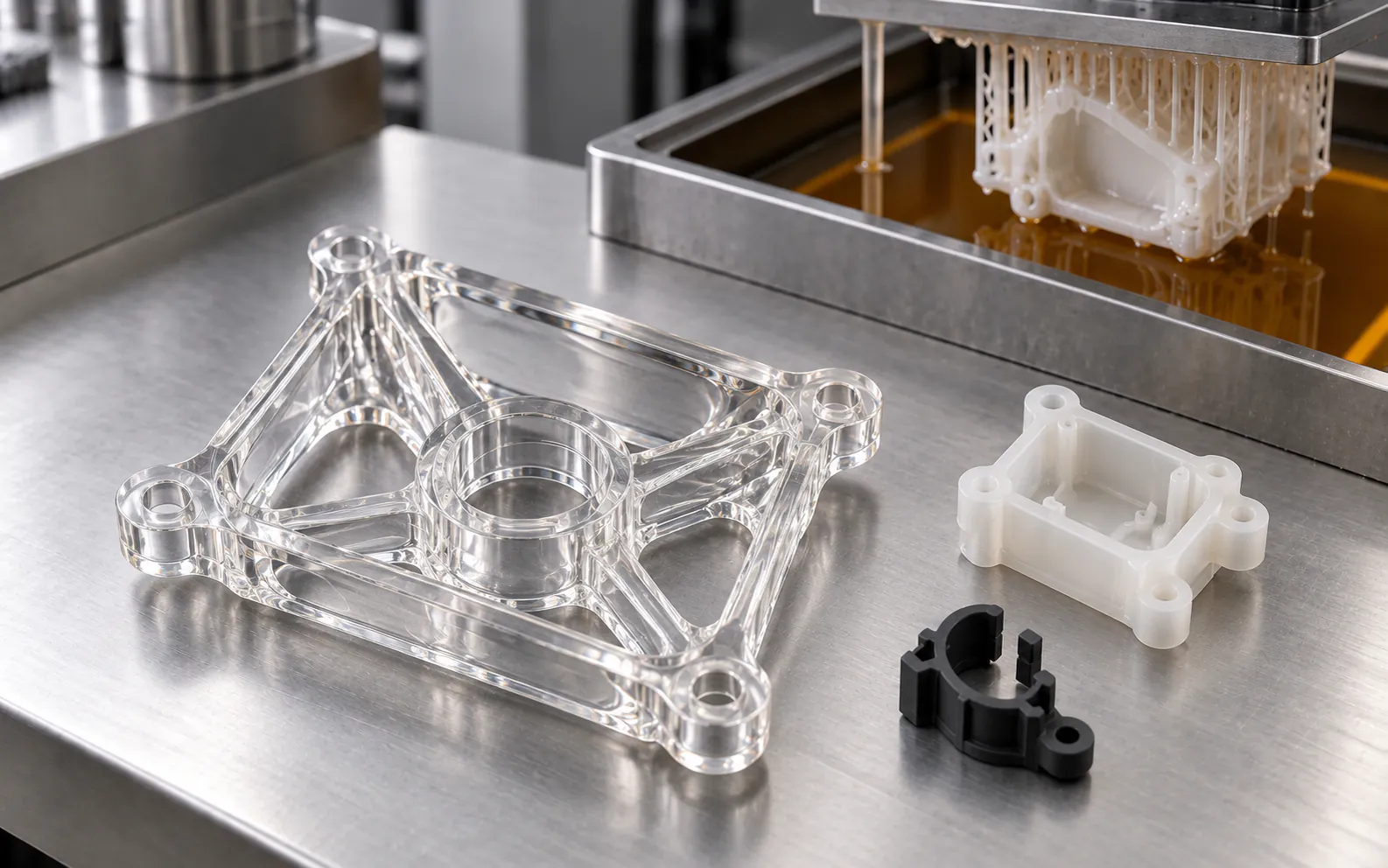
Mock-ups, appearance prototypes and clear parts in white, black or clear resin. Up to 1,650 mm long, from a single unit, with a quote in 24 hours and parts from 7 working days.
01 / What SLA is
Stereolithography (SLA) is a 3D printing technology that hardens liquid resin with an ultraviolet laser, layer by layer. The part comes out smooth and with fine detail, but it grows on supports that are later removed by hand, and it finishes with a final cure. It is the option for parts that are shown, not for parts that work.
Step by step
02 / Resins
All three behave in a similar way to ABS. Choose by color and size: white for painting and for large parts; black to show a black product without painting it; clear to see what is inside.
| Resin | Reference | Temperature* | Elongation | Maximum size | Finish | Purpose |
|---|---|---|---|---|---|---|
| White | Somos® GP Resin | 46 °C | 5 % | 1.650 × 760 × 580 mm | Smooth, natural or painted | Mock-ups, appearance prototypes, parts for painting and large one-piece models. White resin datasheet |
| Black | Somos® Imagine Black | 50 °C | 5 % | 580 × 580 × 380 mm | Matte, black all the way through | Prototypes of black products, electronics housings and parts for display or photography. Black resin datasheet |
| Transparent | Somos® WaterShed XC 11122 | 45 °C | 7,5 % | 780 × 780 × 540 mm | Clear polish, always included | Housings that show the inside, light guides, parts for visualizing a flow and packaging prototypes. Clear resin datasheet |
*Heat deflection temperature according to the resin manufacturer. Above it, the part deforms. Unsure between resin and MJF? The material selector tells you in two steps.
03 / Size and tolerance
Each resin is printed on a different machine: white reaches 1,650 × 760 × 580 mm, clear 780 × 780 × 540 mm and black 580 × 580 × 380 mm. The reference tolerance is ±0.2 mm up to 100 mm and ±0.2% above that.
Mock-ups and presentation models in a single piece, without gluing sections.
A complete housing fits, to show the mechanism or electronics inside.
Enough for most housings and handheld products.
Mark on the drawing the dimensions that have to fit and we review them before printing.
Tolerances by processLarger parts are studied split into sections.
04 / Finishes and limits
SLA gives a smooth surface and fine detail, but the resin is a photopolymer: it softens with heat and is not designed to work.
Support marks are sanded. On curved surfaces the layers may be visible.
White is the ideal base for painting. Black is already colored all the way through: a scratch does not reveal another color.
Every face is sanded and polished and a clear varnish is applied. Without it, the part stays translucent, as do the internal cavities that cannot be reached.
Not suitable for parts that work above 45–50 °C, in the sun for months or under sustained loads. That is what MJF is for.
MJF 3D printing05 / SLA, MJF or vacuum casting
If the part is to be seen and handled, SLA. If it has to withstand loads, impacts or heat, MJF. If you need several copies with the look of the final product, vacuum casting.
| Process | Material | Best for | Keep in mind |
|---|---|---|---|
| SLA | White, black or clear resin | Mock-ups, appearance prototypes, parts for painting and clear parts. | Deforms at 45–50 °C. Parts from 7 working days. |
| MJF | PA12, PA11, PA12 GB, PP and TPA | Functional parts, clips, housings and ducts. MJF 3D printing | Opaque, grainy surface, in gray or black. No clear parts. |
| Vacuum casting | Rigid, flexible or transparent polyurethane | Series of 10 to 300 parts with the look of the final product. Vacuum casting | Needs a master part and a silicone mold, about 20 copies per mold. |
How to order
The 3D model is enough to quote and print. Tell us which faces are visible and whether the part will be painted.
One file per part, in STL, STEP or your CAD format. Choose resin, finish and quantity.
An engineer reviews the part and confirms resin, finish and lead time. If it fits MJF better, they tell you.
Working days from order confirmation. We check every part and ship it anywhere in Europe.
06 / Frequently asked questions
It depends on what the part is for. SLA gives a smooth surface, fine detail and clear parts, but the resin softens at 45–50 °C. MJF gives tough parts that withstand loads, impacts and temperature, with a grainy surface. To show, SLA; to work, MJF.
Yes, in clear SLA resin. It is always delivered polished, and the polishing is included in the price: without it, the part stays translucent. Internal cavities that cannot be reached for polishing stay translucent.
Yes. White resin is the best base for painting in the final color, and black also accepts paint. State the color and the visible faces when you request the quote.
For fit and appearance tests, yes. For real use, no: the resin deforms above 45–50 °C, degrades in the sun and gives way under sustained loads. If the part has to work, print it in MJF.
Supports are cut off by hand and their marks are sanded. On curved surfaces the layers may be visible. If a face has to be perfect, mark it when you request the quote: the orientation of the part decides where the supports go.
From 7 working days after you confirm the order, plus shipping. The exact lead time depends on the resin, the finish and the quantity, and we give it to you in the quote, which you receive within 24 hours.
Not much. In 3D printing, the price per part changes little with quantity: each part uses its own resin and machine time. If you need dozens of identical copies with the look of the final product, compare with vacuum casting.
SLA 3D printing
Choose resin, finish and quantity on the platform. You get the quote in 24 hours.
It opens in a new tab. Accepted formats:
We use our own and third-party cookies to understand how the website is used and which campaigns work. You can accept them all, reject them all or choose which ones; the website works the same either way.We use our own and third-party cookies to measure the website and our campaigns. Cookie policy.