CNC lathe and CNC milling machine: main features and differences
What each machine does, which parts come out of each, which is cheaper for your geometry and what happens when the part needs both.
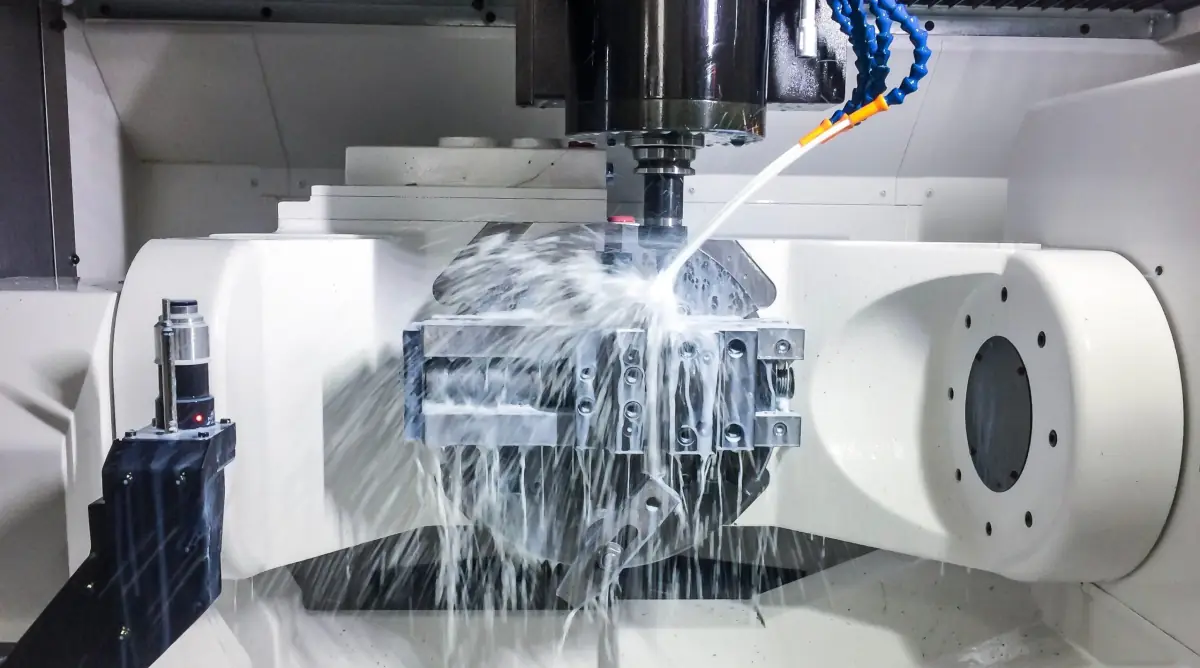
The difference lies in what rotates: in the CNC lathe, the part rotates and the tool moves along two axes (X and Z); in the CNC milling machine, the tool rotates and the part moves along three axes or more. From there, everything else follows: the lathe is the fastest and most economical option for rotational parts (shafts, bushings, bolts), and the milling machine for parts with flat surfaces, pockets, and holes on multiple faces. In a workshop like ours, around three out of every four parts are milled and the rest are turned or a combination of both.
Here we explain how each machine works, what parts come out of each one, which is cheaper, and how it is decided when you request custom CNC machining of parts: you don't have to choose yourself, but it is advisable to understand it to design better.
If the part fits in a cylinder and almost all its geometry is round, turn it. If it has flat faces, pockets, or holes in multiple directions, mill it. If it has both, use both machines.
How does a CNC lathe work?
The part, usually a bar, is clamped in a chuck and rotates at speeds between 500 and 4,000 rpm. The tool, a carbide insert fixed in a turret, advances along (Z axis) and towards the center (X axis). With those two movements, all turning operations are performed:
- Turning: reduces the outer diameter.
- Facing: makes the end face flat.
- Grooving and parting: creates grooves for O-rings or cuts the part from the bar.
- Threading: external or internal, following the pitch with spindle precision.
- Drilling and boring: holes in the axis of the part, and their custom finish.
Current lathes also have live tooling and a C axis: the part stops at an angular position and a small end mill drills a side hole or cuts a flat or a keyway. So a round part with some milled detail comes off the lathe finished, in a single setup.
How does a CNC milling machine work?
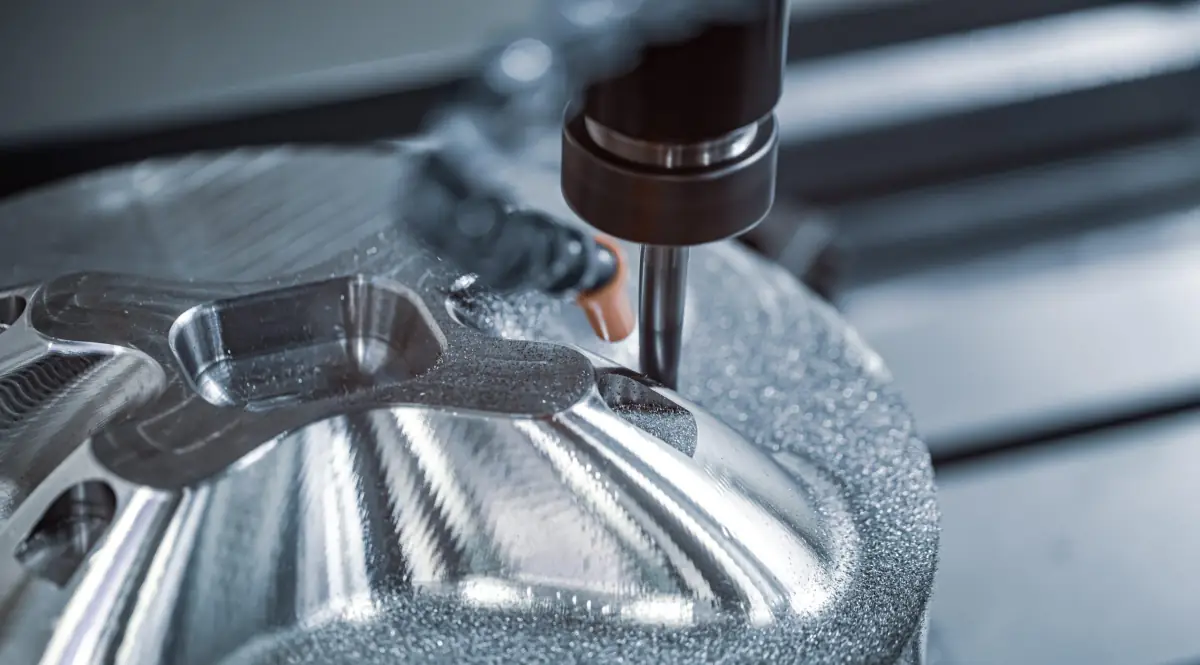
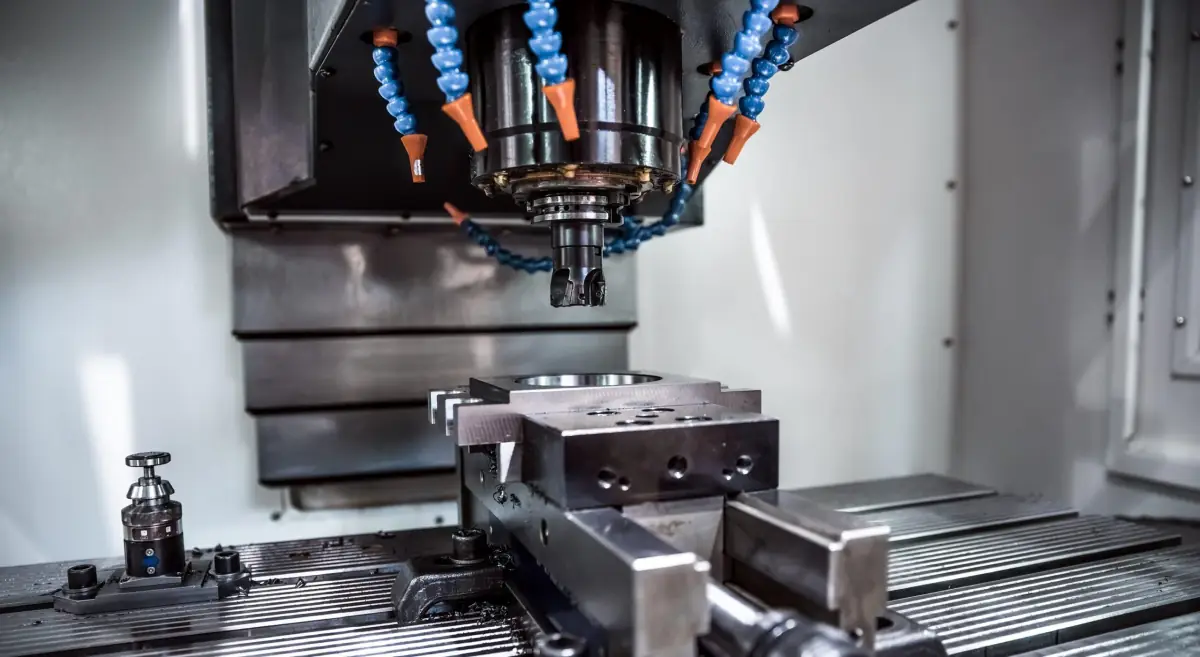
The tool rotates in the spindle head, at between 8,000 and 24,000 rpm on machines for aluminum, and the table with the clamped part moves along X, Y, and Z. With an automatic tool changer of 20 to 40 tools, a machining center chains facing, contouring, pockets, drilling, reaming, and threading without intervention. Depending on the number of axes:
- 3 axes: the part does not rotate. Plates, brackets, housings and pockets. It is the most economical.
- 4-axis: a rotary indexer turns the part to machine several faces without re-clamping.
- 5-axis: the table tilts and rotates. Complex geometries and free-form surfaces in a single setup, as we explain in 5-axis CNC machining.
Every time a milled part is unclamped to machine another face, time and some precision between faces are lost. That is why the number of setups weighs so heavily on price and cutting time.
Comparison table: CNC lathe versus CNC milling machine
| Criterion | CNC lathe | CNC milling machine |
|---|---|---|
| What rotates | The part | The tool |
| Movement axes | 2 (X, Z), plus C and Y with a motorized tool | 3, 4 o 5 |
| Typical geometry | Rotational parts: shafts, bushings, bolts, fittings, pins | Prismatic: plates, brackets, housings, fixtures, molds |
| Starting material | Round or hexagonal bar | Block, plate, or pre-part |
| General tolerance | ISO 2768-f in metal (±0.1 mm in 25 mm) | ISO 2768-f in metal (±0.1 mm in 25 mm) |
| Tightened dimensions | Up to IT6-IT7 in diameters: that's your strength | Up to IT7 in reamed holes and specific dimensions |
| Surface finish | Excellent for diameters (Ra 0.8 to 1.6 µm) | Good for flat faces; curves depend on the pass |
| Time per part | Lower for round parts: removes material continuously | Higher for round parts; unbeatable for prismatic parts |
| Runs | Very efficient with bar feeder | Efficient with multi-part tooling |
Which parts are made on a lathe and which on a milling machine?
They come from the lathe
Shafts and axles, bushings and sleeves, bolts, pins, fittings, nozzles, special nuts and screws, spacers, pulleys, discs, round covers. Anything that turns in the final machine or fits in a round hole. With live tooling, also a shaft with a keyway, a bushing with radial holes or a fitting with two wrench flats.
They come from the milling machine
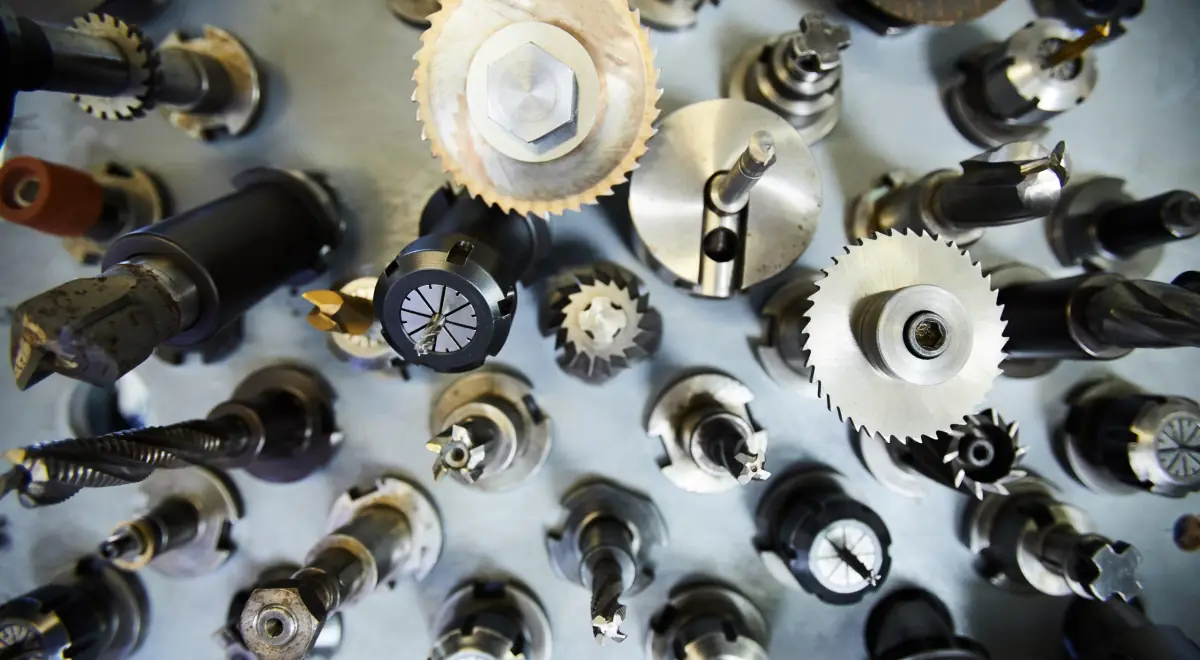
Base plates, brackets and angles, housings and covers, assembly fixtures, valve blocks, mold inserts, arms, guides, parts with pockets, ribs and holes on several faces. In general, any part that starts as a block and has flat faces.
They need both
A shaft with a square flange, a cylindrical housing with side pockets, a disc with an off-axis hole pattern. The round part is turned first and the rest is milled afterwards, or vice versa, with an extra setup that is reflected in the price.
Which one is cheaper?
For a round part, the lathe, by far. It removes material continuously, in a single setup, and a 100 mm shaft is made in a few minutes. The same part on a milling machine would require multiple setups and a rotating cutter, taking more time and resulting in worse roundness.
For a prismatic part, there is no choice: it is a milling machine. What you decide is how much it costs inside the milling machine. Three things that lower the price:
- Fewer machined faces: each face can be a setup. If the drilled holes can all go from the top, the part is cheaper.
- Large internal radii (1 mm or more) and shallow pockets: allow large and fast end mills. We explain this in different machining tools.
- Tolerances only where needed: the general ISO 2768-f is already fine. A dimension at ±0.02 mm is charged separately. More details in tolerances in CNC machining.
And on either of the two machines, quantity rules: programming, workholding and setup are paid once, so the 10th part costs much less than the 1st. When requesting the quote, you can compare up to three quantities.
How is it decided at Proto&Go!?
You do not have to indicate the machine. You upload the STEP, choose the material, quantity, and finish, and an engineer reviews manufacturability: decides on a lathe, 3 or 5-axis milling machine, or a combination according to the geometry, and returns the quote in 24 h with price and lead time. Parts are delivered from 8 working days and each is verified before shipping.
The only thing that is advisable to add is a PDF with the threads (the 3D model does not specify the metric) and the dimensions that require a specific tolerance, for example the diameter of a shaft that fits into a bearing. To calculate that fit, you have the shaft-hole fit calculator.
Frequently asked questions about lathe and CNC milling
What is the difference between a CNC lathe and a CNC milling machine?
On the lathe, the part rotates and the tool advances on two axes; it is the machine for rotational parts. On the milling machine, the tool rotates and the part moves on three or more axes; it is the machine for parts with flat faces, pockets, and drilled holes in various directions.
When is CNC turning preferred over milling?
When the part is rotational: shafts, bushings, bolts, or fittings. Turning is faster and more economical in those geometries and achieves better roundness and finish on diameters. If the round part has flat surfaces or side drilled holes, turning and milling are combined.
Can a round part be made on a milling machine?
Yes, but it usually costs more and comes out worse. The end mill traverses the circumference by interpolation, with more machine time and lower roundness than the lathe. It only pays off for large, flat round parts, such as discs with drilled holes.
Do I have to specify in the order if my part is for turning or milling?
No. The engineer reviewing each order chooses the machine based on the geometry and material, and the quote already takes this into account. You only indicate material, quantity, finish, and, in a PDF, threads and dimensions with tolerance.