5-axis CNC machining: everything you need to know
What the two rotary axes add, when it pays off over 3-axis, which parts really need it and how to design them to come out in a single setup.
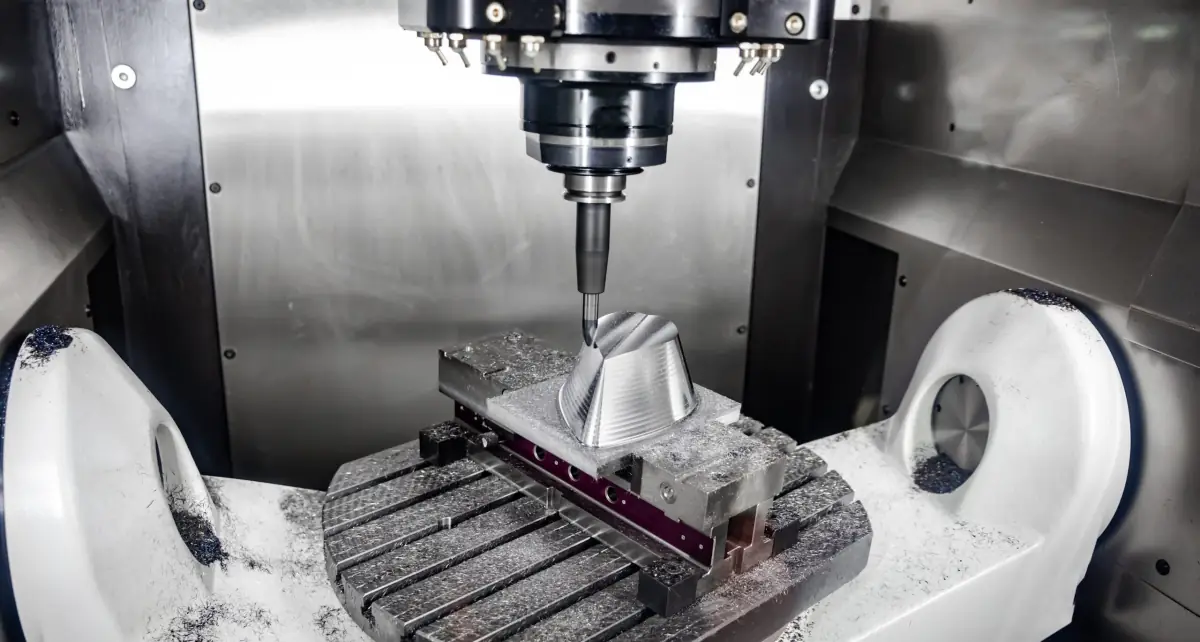
5-axis CNC machining adds two rotations to the three X, Y, and Z movements of a mill: the table or head tilts and rotates, and the tool reaches five sides of the part in a single setup. What 3-axis requires three or four setups (and accumulated error between sides), 5-axis is done all at once. Still, most parts in a shop remain 3-axis: 5-axis is used where it saves setups or where it enables a geometry.
This guide explains what it is, how 3+2 differs from continuous 5-axis, which parts require it, when it is more cost-effective, and how to design to leverage it. If you request custom CNC machining, you do not need to choose the machine: the engineer reviewing the order decides for you.
5-axis does not mean more expensive. A part with inclined drilled holes or five-sided machined faces comes out cheaper on a 5-axis setup than on four 3-axis setups, and with better face-to-face precision.
What is 5-axis machining?
A 3-axis mill moves the tool in X, Y, and Z over a fixed part: it only machines what it sees from above. A 5-axis center adds two rotation axes, called A, B, or C depending on the axis around which they rotate, and with them orients the part (or the head) so the tool attacks from any direction. There are three common configurations:
- Table-table (saddle or trunnion): the table tilts and rotates. It is the most common for small and medium parts, rigid and precise.
- Head-table: the head tilts and the table rotates. For larger and heavier parts.
- Head-head: both rotations are in the head. For very large parts, aerospace, and molds.
3+2 versus continuous 5-axis: they are not the same
There are two ways to use the five axes, and the difference matters for the price:
| Mode | How it works | Purpose | Programming |
|---|---|---|---|
| 3 axes | Fixed part; the tool moves in X, Y, Z | Plates, pockets, brackets; one or two sides | Simple |
| 3+2 (positional) | The rotations orient the part and lock; then it is machined on 3 axes | Most 5-axis parts: multiple sides, inclined drilled holes, angled pockets | Medium: one operation per orientation |
| 5-axis simultaneous | The five axes move simultaneously during cutting | Free surfaces: impellers, flanges, implants, complex molds | Complex: specific CAM and simulation |
The 3+2 approach offers almost all the advantages (one setup, precision between faces, short tools) with simple and quick programs. The 5-axis simultaneous approach is reserved for surfaces that cannot be machined any other way, and its programming is what weighs most on the unit part price.
What advantages does it offer compared to 3-axis machining?
- A single setup. Each 3-axis setup means minutes of preparation and a source of error: when repositioning the part, faces stop being perpendicular or concentric by a few hundredths. In 5-axis, all faces are referenced to the same zero.
- Shorter tools. By tilting the part, the end mill reaches deep areas without a long overhang: less vibration, better finish, and higher speed.
- Impossible geometries in 3-axis. Oblique drilled holes, inclined faces, angled pockets, continuous curved surfaces.
- Less tooling. No need for a fixture per face or for tombstones.
The counterpoint: the machine costs more per hour, programming is more demanding, and the useful work volume is lower than that of a 3-axis machine of the same size, because the bed occupies space.
What parts are machined on 5-axis?
- Hydraulic and pneumatic blocks with drilled holes in various directions and at non-orthogonal angles.
- Housings and bodies with inclined faces, 45° flanges, or oblique connections.
- Impellers, propellers, and flanges: free surfaces that require 5-axis simultaneous machining.
- Automotive racing and aerospace parts: brackets and linkages machined from the block in a single setup.
- Implants and surgical guides, in titanium or PEEK, with organic shapes.
- Mold inserts and electrodes with deep ribs and inclined walls.
- Prototypes that mimic an injection molded part, with demolding angles on all sides.
How much does it cost compared to 3-axis?
The hour of a 5-axis machine is more expensive than a 3-axis, so on a plate with pockets and holes on top, 3-axis always wins. The calculation changes with setups: starting from three setups in 3-axis, 5-axis usually comes out cheaper, because it adds preparation time, fixtures, and error risk at each change. And for unit parts, 3+2 avoids making a fixture that would only be used once.
In a short run, the difference is more noticeable: twenty parts with four setups are eighty setups; with 5-axis, it's twenty. When requesting a quote, you can compare up to three quantities and see how the unit price drops. And there are more ways to reduce it, which we summarize in how to optimize CNC machining and reduce costs.
How to design a part for 5-axis machining
- Leave a clamping area. The part is held by a face or by a tenon that is cut at the end; if all faces are machined, you must plan where it is gripped.
- Generous internal radii, of 1 mm or more, as in any milled part. The end mill remains round.
- Accessible pockets. Tilting the part allows using short end mills, but a pocket 60 mm deep and 8 mm wide remains slow on any machine.
- Standardized drill holes even if inclined: 4, 5, 6, 8, 10 mm. An unusual angle costs more; an unusual diameter, yes.
- A drawing with references. If two faces must be perpendicular or two drilled holes concentric within hundredths, specify it: that is exactly what 5-axis machining guarantees best. The guide to CNC machining tolerances explains how to write it.
- Walls of 0.8 mm or more in metal: the inclined part vibrates just as the straight one if the wall is thin.
The design rules for machining on the service page illustrate each one with an example.
How to order a 5-axis part
Just like any other: upload the STEP, choose material (aluminum, steel, stainless steel, brass, titanium, or an engineering plastic), quantity and finish, and add a PDF with threads and tolerances. The engineer reviews manufacturability, decides 3, 3+2, or 5-axis simultaneous according to the geometry, and sends you the quote in 24 hours. Parts are ready from 8 working days, with each functional dimension verified before shipping. If you are unsure between milling and turning, you have the comparison in CNC lathe and CNC milling machine: differences.
Frequently asked questions about 5-axis machining
What is the difference between 3, 4, and 5-axis milling?
With 3 axes, the tool moves in X, Y, and Z over the fixed part: the most economical option for plates, pockets, and brackets. The fourth axis adds a rotation to machine multiple faces without re-clamping. With 5 axes, the table tilts and rotates, allowing complex geometries and free-form surfaces in a single setup.
Is 5-axis machining always more expensive?
No. The machine hour is costlier, but from three setups on 3-axis, 5-axis usually comes out cheaper, as it eliminates setups, tooling, and errors between faces. For a simple plate, 3-axis remains cheaper.
What is 3+2 axis machining?
It uses the two rotation axes to orient and lock the part, then machines in 3 axes from that orientation. It covers most 5-axis parts with simple programs. Simultaneous 5-axis, with all five axes moving at once, is reserved for free-form surfaces.
Do I need to specify that my part is 5-axis when ordering?
No. You upload the 3D model and the engineer reviewing the order selects the machine based on the geometry. It is only advisable to add a PDF with the threads and tolerances between faces you require.