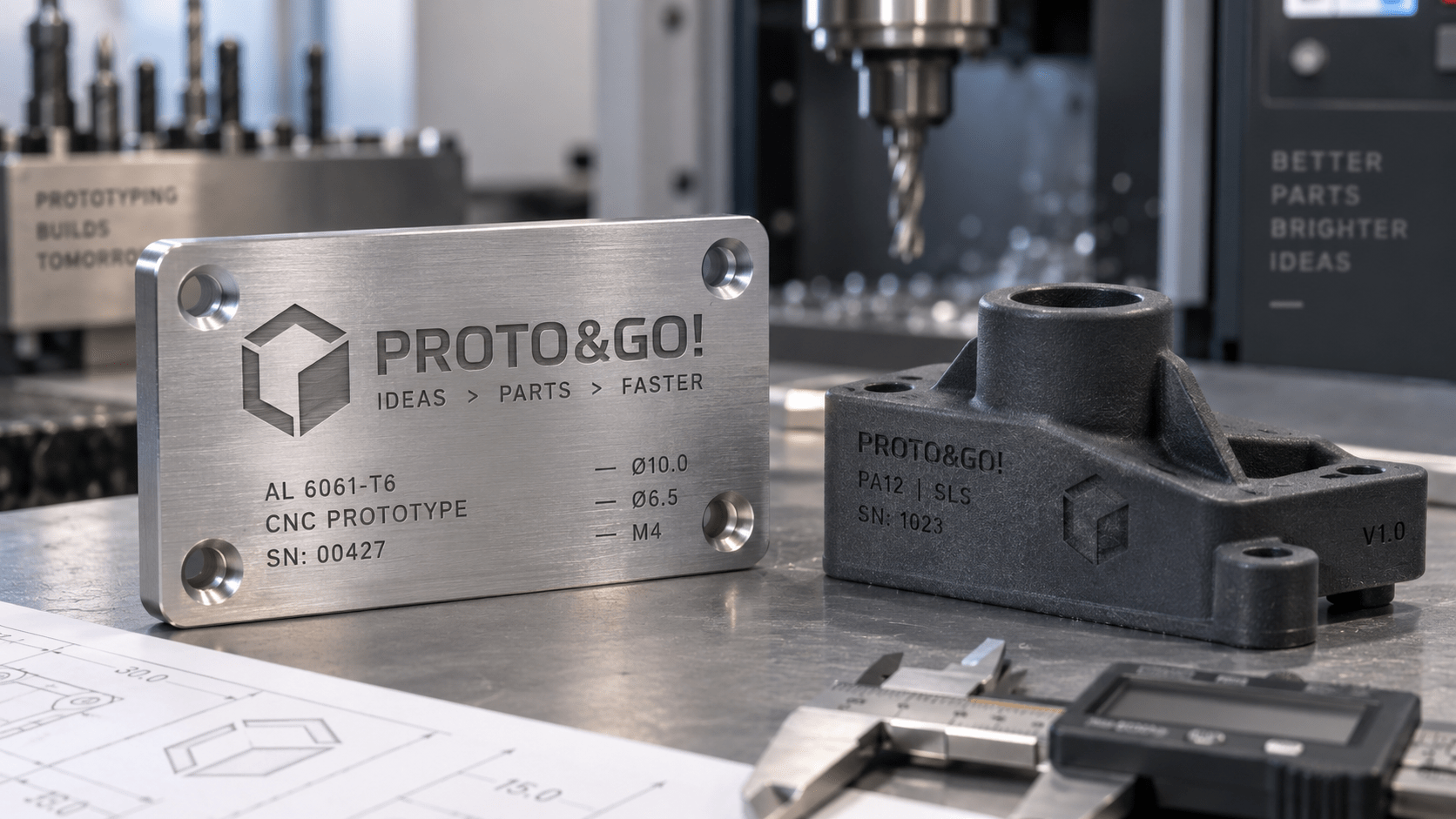
Including text, a reference, a serial number, or a logo on a part or prototype may seem like a simple design detail. However, when that information must be produced using CNC machining, 3D printing, or engraving, the final result depends on several factors: size, line thickness, depth, geometry, material, and surface finish.
Including text, a reference, a serial number, or a logo on a part or prototype may seem like a simple design detail. However, when that information must be produced using CNC machining, 3D printing, or engraving, the final result depends on several factors: size, line thickness, depth, geometry, material, and surface finish.
Properly designing the text and logos engraved on parts and prototypes helps prevent rework and ensures that the identification, brand, or technical information remains visible on the final product.
What is the difference between engraved text and raised text?
Before determining the dimensions, it’s a good idea to decide how the text will be incorporated into the piece.
An engraving creates a recessed pattern on the surface. It is commonly used on machined parts, plates, industrial components, housings, or parts that require permanent markings.
Embossed text, on the other hand, protrudes from the surface of the piece. It can work well on certain 3D-printed pieces or plastic items, although it is also more vulnerable to impacts, wear and tear, or subsequent processing.
From a manufacturing standpoint, both solutions require controlling the minimum size of the details and ensuring that the selected technology can reproduce them.
Minimum text size: There is no universal standard
One of the most common questions is what the minimum size is for engraving text on an item. There is no single answer. Legibility depends on:
- Manufacturing technology.
- Material.
- Tool diameter in CNC machining.
- 3D printing resolution.
- Depth or height of the engraving.
- Font type.
- Subsequent surface finishing.
- The distance from which it should be read.
As a design guideline, the smaller the text, the more important it is to use simple, sufficiently thick strokes. A 2-mm-high typeface with very thin strokes may be less legible than one that is slightly larger and has a more open structure.
When space is available, moderately increasing the text size is usually safer than working close to the technological limits of the process.
Choosing the Right Materials for CNC Machining and 3D Printing
Typography directly affects manufacturability. For CNC-engraved text, simple, sans-serif fonts with uniform strokes generally work best. Excessively decorative fonts may include small curves, narrow spaces, or details that are impossible to reproduce with a given tool.
Sans serif fonts are often a more robust choice for industrial applications.
It’s also a good idea to pay special attention to words such as:
- A, R, P, or B, based on their internal voids.
- M and W, because of the closeness of their strokes.
- E, F, or T, when the lines are too thin.
- Small numbers, especially 3, 6, 8, and 9.
In 3D printing, excessively fine details should also be avoided, as they may lose definition depending on the orientation, resolution, and process used.
Line thickness: just as important as line height
It’s not enough to simply increase the height of the letters. The minimum stroke width is one of the factors that most significantly affects legibility.
A large letter drawn with extremely fine lines may disappear during machining or appear blurry after finishing.
In CNC machining, the inner radius of the letters is also determined by the tool’s diameter. If the design includes inner corners that are too small, the final geometry must be adapted to the radius of the end mill.
For this reason, it is advisable to think of text as a form that can be constructed, not merely as a graphic element.
Engraving depth: more isn’t always better
The depth of the CNC engraving should be sufficient for the text to remain visible after finishing, but it does not necessarily have to be very deep.
An engraving that is too deep can increase machining time, create areas that are difficult to clean, cause paint or dirt to accumulate, weaken very thin walls, or make a small detail appear too harsh.
On the other hand, an engraving that is too shallow may lose contrast after sanding, polishing, anodizing, or painting.
Therefore, the depth must be defined by taking into account both the manufacturing process and the final finish of the part.
How Finishes Affect Engraved Text
One of the most common mistakes is to design the engraving with only the newly manufactured piece in mind.
Subsequent processes such as sandblasting, polishing, painting, anodizing, or surface coatings may slightly alter the edges and reduce the definition of small details.
Paint can partially fill shallow engravings. Polishing can smooth the edges. Sandblasting can reduce the contrast of very fine lettering.
For this reason, if the text is to remain perfectly legible, it is advisable to consider the intended finish from the outset.
A common strategy is to slightly increase the size, line thickness, or depth compared to a design that will not undergo any further processing.
Logos: Simplifying Them Can Improve the Result
Logos often present an additional challenge because they may contain very small details that were not designed with manufacturing in mind.
Before machining or printing a logo, you may need to:
- Remove items that are too small.
- Increase line spacing.
- Simplify curves.
- Thicken certain lines.
- Create a monochrome version specifically for manufacturing.
It is not always necessary to reproduce the original graphic file with absolute fidelity. In many applications, an optimized version preserves the visual identity and produces a much cleaner result.
Engraved or Printed Text: Which Should You Choose?
Not all text needs to be part of the piece’s geometry.
For variable identifiers, serial numbers, or codes, it may be more efficient to use technologies such as laser marking at a later stage.
On the other hand, when the information must remain physically integrated into the part, machined or printed engraving offers a permanent and durable solution.
The choice will depend on the number of parts, the material, the finish, and whether the contents are fixed or vary from unit to unit.
Upload your file and receive your quote online now.