How to avoid defects in vacuum casting.
Vacuum casting in silicone molds yields plastic parts with very good finish and properties adapted to each application. To obtain consistent results, you must understand why common defects appear.
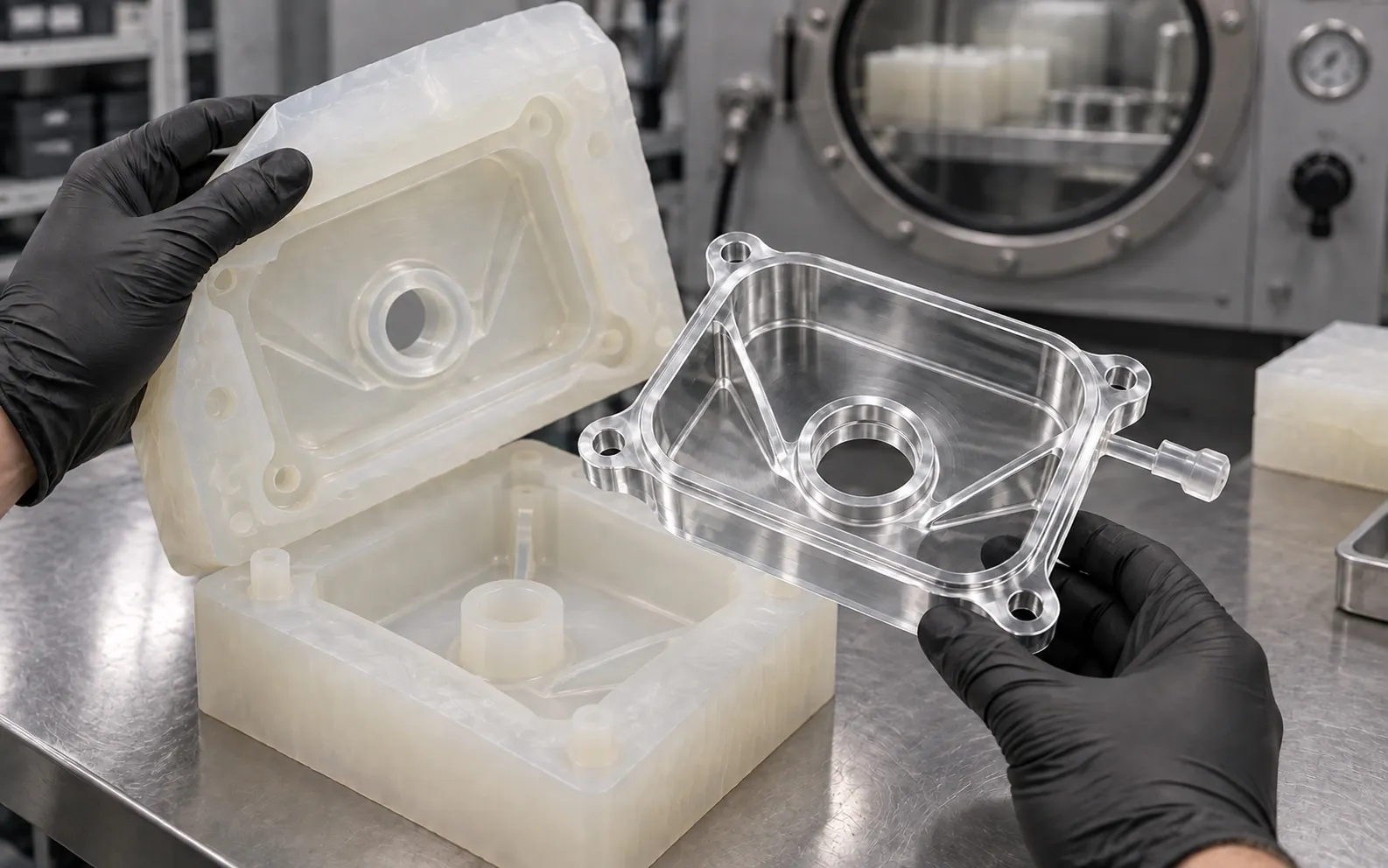
Vacuum casting in silicone molds is one of the most used technologies for manufacturing plastic parts in functional prototypes and short runs. With silicone molding and a wide range of polyurethanes, it is possible to obtain parts with very good surface finish, tight tolerances, and mechanical properties adapted to each application.
These are the most common problems, their origin, and the most effective solutions, both from the part design and from the polyurethane casting process itself.
Air trapped during mixing or filling.
Two material fronts meeting.
Unequal wall thicknesses and uncontrolled curing.
Air bubbles in vacuum casting: causes and solutions
Air bubbles are one of the most frequent defects and are usually directly related to the way the material flows and displaces air inside the mold. They appear when air gets trapped during filling or when the polyurethane resin does not have enough fluidity to occupy all the volumes. Another common cause is air trapped during the mixing of the polyurethane resin before pouring.
- Avoid complex geometries with abrupt section changes or high zones without air evacuation.
- Design properly dimensioned gating channels.
- Place strategic vents so that air escapes during filling.
- Control the vacuum cycle.
- Use polyurethanes of appropriate viscosity and adjust the casting speed.
- Degas the polyurethane resin under vacuum before casting.
Working with a polyurethane resin of appropriate viscosity and an adjusted casting speed promotes continuous flow and reduces bubble formation, even in parts with fine details. Pre-degassing eliminates air introduced during mixing and significantly improves the part's surface finish.
Parting lines and flow marks in cast parts
Weld lines appear when two material fronts meet inside the mold. Although in many cases they are primarily an aesthetic defect, in certain applications they can affect the mechanical strength of the part.
- Uncontrolled material entry or excessively long flow paths.
- The polyurethane resin cools or begins to gel before joining.
- Temperature differences between the silicone mold and the polyurethane resin or excessive viscosity.
- Simplify the material path and define a single casting point.
- Use smooth radii and progressive section changes.
- Keep the mold and polyurethane resin temperature stable.
Smooth radii and progressive section changes facilitate homogeneous polyurethane casting flow, and a stable mold and polyurethane resin temperature helps the material fronts fuse correctly.
Shrinkage and warping in silicone molds
Shrinkage is an inherent phenomenon in many materials used in polyurethane casting and can lead to warping or dimensional deviations if not accounted for from the start of the project.
- Avoid large differences in wall thickness and material concentrations.
- Aim for the most homogeneous wall thicknesses possible.
- For demanding parts, account for compensations in the pattern or mold.
- Choose a polyurethane with lower shrinkage and better dimensional properties.
- Control the curing cycle.
- Respect demolding times to avoid internal stresses.
A balanced design contributes decisively to reducing this problem. The same wall thickness rules apply to other technologies: consult how to avoid warping in 3D printing and CNC.
Process diagnosis and optimization
In vacuum casting, there is no single cause for each defect. In most cases, problems arise from the combination of the part design, mold design, and process parameters. Therefore, a good initial diagnosis is fundamental to reduce iterations, development times, and costs.
Analyzing the material, flow within the mold, and manufacturing conditions from the early stages avoids repeating the casting.
This analysis is especially important for short runs or pre-validations before industrial processes. At Proto&Go! we work with a wide range of polyurethanes to adapt the mechanical, thermal, and aesthetic properties of each part to its final use, whether in functional prototypes or short runs.